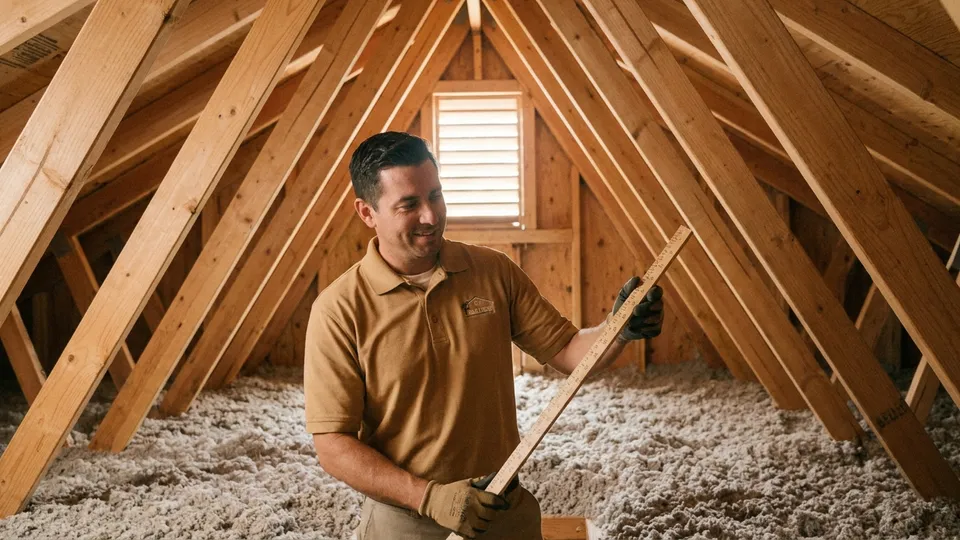
For most San Diego homes the answer is: blown-in cellulose or fiberglass to R-49 in the attic, dense-pack cellulose or spray foam in the walls, and spray foam or rigid foam on the crawlspace. That covers 80 percent of the houses we see. The right choice for your house depends on where the insulation goes, what’s already there, and which Title 24 climate zone you’re in.
Here’s the breakdown, room by room.
Why San Diego’s climate shapes every choice
San Diego is cooling-dominated and mild. You’re not fighting a Minnesota winter, so the raw R-value isn’t the only variable. The marine layer brings moisture from the coast inland most mornings, which matters for material selection. East County (Santee, El Cajon, Alpine) runs hotter and drier, so radiant barrier becomes more valuable there. The county spans four Title 24 climate zones, with most of the coastal and central county in Zone 7 and inland valleys in Zone 10.
A few things follow from that:
You can get most of the benefit at moderate R-values. The jump from R-19 to R-38 in the attic is significant. The jump from R-38 to R-49 is meaningful but smaller. Beyond R-49 the marginal return is thin for our climate.
Air-sealing matters as much as R-value. In a mild climate, a leaky envelope lets in conditioned air year-round. Every material recommendation below assumes you’ve air-sealed first. If you haven’t, that work comes before insulation. We cover the why in our post on air sealing before insulation.
Moisture tolerance matters more than it does in dry climates. Cellulose and open-cell foam handle incidental moisture better than fiberglass batts do. That shifts some calls in favor of those materials, especially in coastal neighborhoods.
Room-by-room recommendations
Attic
The attic is the single highest-return insulation project for most San Diego homes. A vented attic with a hot roof deck above it is where the majority of heat enters in summer. Get this right first.
Best method for most homes: blown-in cellulose or blown-in fiberglass to R-38 to R-49.
Blown-in fills around existing joists, wiring, and blocking without cutting. It’s the fastest way to go from under-insulated (R-11 or R-19 is common in older SD homes) to code-compliant. Cellulose (R-3.7 per inch) gets to R-49 in about 13 inches. Loose-fill fiberglass (R-2.5 per inch) needs closer to 20 inches for the same R-value, which matters in shallow truss attics.
If your attic is vented and you want air-sealing bundled with the insulation work, blown-in cellulose is the natural pairing: the crews we send seal penetrations at the top plate, then blow in the product.
For hot roofs or unvented cathedral ceilings: closed-cell spray foam applied to the underside of the roof deck. It air-seals and insulates simultaneously. Target R-20 to R-30 at the deck depending on assembly depth. This is a more expensive path, but it’s sometimes the only path when venting isn’t an option. Learn more about the service on our attic insulation page.
Add a radiant barrier if you’re in Zone 10 or east county. A foil barrier stapled to the underside of roof rafters cuts radiant heat load before it reaches the insulation at the floor. It’s most effective in high-solar-gain zones. Less impactful on the coast where cloud cover is frequent.
Walls
Walls are trickier to retrofit than attics because you can’t just blow in from above. Most San Diego homes built before 1980 have little to no wall insulation. Homes built after 1990 usually have R-11 to R-13 batts in 2x4 walls, which meets old code but leaves room for improvement.
Best method for retrofits: dense-pack cellulose.
Dense-pack cellulose is installed by drilling small holes in the exterior (behind the siding) or interior (behind drywall), injecting cellulose at high density, then patching the holes. The density (around 3.5 lb/ft³) prevents settling and provides meaningful air resistance. A 2x4 wall gets to R-13; a 2x6 wall reaches R-19 to R-21.
It’s less disruptive than opening walls and avoids the thermal bridging issues that come with batts that aren’t tight against the framing.
When spray foam makes sense in walls: open-cell spray foam in new or gutted walls gives R-3.7 per inch with excellent air-sealing built in. It’s a good choice when walls are already open for a remodel. Closed-cell adds R-6.5 per inch but costs significantly more and is rarely necessary in San Diego’s mild climate. Detailed comparison by product and climate on our wall insulation page.
What to avoid: fiberglass batts in an existing wall cavity without air-sealing the top and bottom plate first. Batts with gaps or voids around wiring and blocking perform at half their rated R-value or worse. If you’re doing batts, pair them with foam at every penetration.
Crawlspace
A vented crawlspace under a San Diego home brings in the marine layer every morning. That means humidity, and often mold risk on subfloor framing over time. The best-performing solution seals the crawlspace rather than venting it.
Best method: closed-cell spray foam on the crawlspace walls and rim joists, with a vapor barrier on the ground.
Encapsulating the crawlspace (sealing the perimeter walls rather than insulating the floor above) creates a semi-conditioned space. Pipes don’t sweat, ducts don’t lose conditioned air to uncontrolled air, and mold risk drops substantially. Target R-10 to R-15 continuous on the walls.
If full encapsulation isn’t in the budget: fiberglass batts between the floor joists (R-19 to R-25) with the paper facing up toward the conditioned space, plus a ground vapor barrier. It’s a partial solution, but it’s meaningfully better than nothing and it’s what Title 24 Zone 7 requires as a minimum for floor assemblies over unconditioned spaces.
More detail on materials, costs, and moisture management on our crawlspace insulation page.
Garage
Most garages in San Diego aren’t conditioned spaces, and insulating them falls into two different goals: comfort in an attached garage workshop, or protecting the adjacent conditioned living space from temperature and noise transfer.
For thermal separation between garage and living space: R-13 to R-19 batts in the shared wall and ceiling (the floor/ceiling assembly above the garage if it’s a two-story), plus foam sealing at penetrations. This is also where you address the air-sealing gap between garage and house, which is a meaningful heat and fume path.
For a conditioned or habitable garage: treat it like a room addition. Batts in the walls, blown-in on the ceiling or roof deck, and air-sealing throughout. If you’re converting to an ADU, Title 24 sets specific requirements. Detailed guidance on our garage insulation page.
The garage door itself is often the weakest link. An insulated garage door (R-9 to R-18 panels) combined with perimeter weatherstripping dramatically reduces the thermal and noise load before the insulation in the walls does any work.
Soundproofing
Sound control in San Diego most often means: noise from adjacent units (condos, townhomes), street traffic, or aircraft corridors. The material physics are different from thermal insulation but there’s meaningful overlap.
Best method for sound: mineral wool batts (Rockwool/Comfortboard) in interior partition walls, combined with resilient channel or mass-loaded vinyl on the drywall.
Mineral wool has a density and fiber structure that absorbs sound in the speech-frequency range (500 Hz to 4,000 Hz) better than fiberglass at the same thickness. In a 2x4 wall cavity, R-15 mineral wool outperforms R-13 fiberglass for sound attenuation.
But the insulation material is only part of the answer. Airborne sound travels through gaps. A bead of acoustic caulk around every outlet, switch, and pipe penetration matters as much as the product in the cavity. Decoupled assemblies (resilient channel + two layers of drywall) are the structural solution when the target is serious sound reduction.
For bedrooms near a street, airport corridor, or shared wall in a multi-unit building, the combination of mineral wool plus decoupled drywall plus perimeter caulking drops transmission considerably. We cover the full approach on our soundproofing insulation page.
Recommendation table by location
| Area | Best material | Target R-value | Notes |
|---|---|---|---|
| Attic (vented) | Blown-in cellulose | R-38 to R-49 | R-38 minimum Zone 7; R-49 preferred |
| Attic (unvented/cathedral) | Closed-cell spray foam | R-20 to R-30 at deck | Air-seals and insulates in one step |
| Walls (retrofit) | Dense-pack cellulose | R-13 (2x4) / R-19 (2x6) | Drill-and-fill from exterior or interior |
| Walls (new/open) | Open-cell spray foam or batts | R-13 to R-21 | Foam for built-in air-sealing |
| Crawlspace walls (encapsulated) | Closed-cell spray foam | R-10 to R-15 continuous | Best for coastal moisture control |
| Crawlspace floor (vented) | Fiberglass batts | R-19 to R-25 | Faced up, vapor barrier on ground |
| Garage/living wall | Fiberglass or mineral wool batts | R-13 to R-19 | Seal penetrations; check ADU code |
| Interior partitions (sound) | Mineral wool batts | R-15 | Pair with decoupled drywall assembly |
What Title 24 requires in San Diego
California’s Title 24 sets the floor, not the target. For permit-triggered work in the two most common SD climate zones:
Zone 7 (coastal, most of the county): R-30 attic minimum on a roof alteration, R-13 walls (2x4 framing), R-19 floors over unconditioned space.
Zone 10 (inland: Escondido, El Cajon, Santee, Lakeside): R-38 attic minimum, R-13 walls, R-19 floors over unconditioned space.
We typically exceed minimums by 15 to 25 percent because the marginal cost at install time is low and the comfort difference is real. A full breakdown of zone requirements is in our post on Title 24 insulation requirements for San Diego.
Financial picture
The federal 25C tax credit expired for installs after December 31, 2025, so it no longer applies to new projects. SDG&E offers rebates for attic insulation that can offset $100 to $400 depending on square footage and current R-value, and they don’t require a permit-triggered project. Program funding cycles change, so confirm what’s active at quote time.
For a deeper look at what the numbers look like in San Diego, our r-value guide covers diminishing returns by R-level and how to think about the return on each increment.
Getting it right
The best insulation for any San Diego home is the product matched to the assembly, the climate zone, and the existing conditions. A spray foam specification that’s perfect for a coastal crawlspace is overkill for a garage partition wall. An attic blown to R-49 in a vented assembly is a different project than the same R-value sprayed to a cathedral ceiling.
If you’re not sure what your home needs, we offer a free on-site assessment. We’ll look at what’s there, where the gaps are, and give you a specific recommendation with actual numbers. Call (858) 925-5546 or schedule through the contact page.