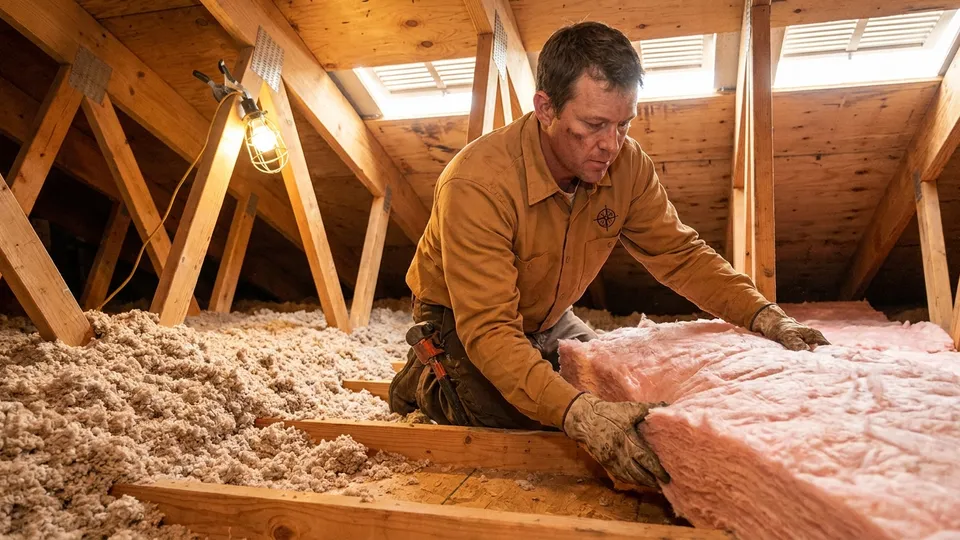
For a typical San Diego attic floor, blown-in wins. It covers obstacles, fills voids, and holds its rated R-value across the whole plane in a way that cut-and-fitted batts rarely match in practice. Batts still earn their place in open walls, cathedral ceilings, and anywhere sound performance is a goal. The decision turns on application, not brand loyalty.
This post is a form-factor comparison: loose-fill blown vs. precut batts. If you want a material comparison inside the batt category, the mineral wool vs. fiberglass batts post covers that side-by-side.
Why form factor matters more than most people expect
When contractors talk about insulation, they often jump straight to R-value per inch. That number matters, but it assumes perfect coverage. In an attic, you rarely have perfect coverage with batts. Joists, cross-bracing, wiring, junction boxes, and old ductwork all create obstacles that a batt has to be cut around. Those cuts leave gaps, and gaps are where your rated R-value falls apart.
Blown-in material flows around all of it. Pour enough through the hose and it fills, regardless of what’s in the way.
Coverage and voids: the main reason blown-in dominates attics
The biggest real-world difference between these two form factors is void coverage.
Batts in an attic floor have to be trimmed, split, and fitted around every joist bay irregularity. One miscut or a batt that gets pulled short creates an uncovered strip. Heat moves through that strip at zero insulation resistance. You can’t see it once the attic is insulated, and it doesn’t show up in a bag count.
Blown-in fills the plane. Material flows under wiring, into the corners of joist bays, and around junction boxes without any cutting or fitting. A depth gauge staked into the joists proves coverage at every point. That’s verifiable in a way that a batt job isn’t.
Coastal and inland San Diego homes tend to accumulate attic irregularities over decades: added ductwork, old bathroom fans, cross-strapping for structural upgrades. Blown-in handles those without a second thought.
R-value consistency
A batt rated R-38 delivers R-38 only when it’s installed without compression, gaps, or voids. Compression anywhere, from a duct sagging on a batt or from a too-narrow joist bay, drops the effective R-value. An R-38 batt compressed to three-quarters of its rated thickness might deliver closer to R-30.
Blown-in doesn’t compress the same way. It settles slightly, which is why a good installer blows to a target depth that accounts for that first-year settlement. Cellulose settles about 15 to 20 percent; fiberglass loose-fill settles less. Both products are factory-rated to account for this if you hit the right installed depth.
The takeaway: a properly installed blown-in job produces more consistent R-value across the whole attic floor than a batt job in a real attic with obstacles.
Settling over time
Settling is a legitimate concern with loose-fill, and it’s worth being direct about it.
Cellulose settles more than fiberglass blown-in, and more than batts. A cellulose attic that was blown to R-49 depth might settle to closer to R-38 over five to ten years if it wasn’t installed with that in mind. The fix is straightforward: install to the depth that accounts for the settled final R-value. Industry installation tables for cellulose give you both the initial depth and the settled depth for the rated coverage. An installer who only gives you the initial depth number is leaving you short.
Fiberglass batts don’t settle in the same way, but they do sag, shift, and fall short around obstacles over time. Whether settled cellulose or gapped batts is the worse outcome depends on the job.
Cost comparison by application
San Diego installed cost ranges, typical residential attic or wall:
| Application | Blown-in | Batts |
|---|---|---|
| Attic floor, empty (to R-49) | $1.50-$2.80/sq ft | $1.20-$2.10/sq ft |
| Attic floor, top-up over existing | $0.90-$1.60/sq ft | $0.80-$1.40/sq ft |
| Open wall cavity (2x4, R-15) | Not ideal | $1.10-$1.80/sq ft |
| Open wall cavity (2x6, R-21) | Not ideal | $1.20-$2.00/sq ft |
| Dense-pack retrofit wall (closed cavity) | $2.80-$4.50/sq ft | Not applicable |
| Cathedral ceiling (open cavity) | Not ideal | $1.40-$2.20/sq ft |
Batts are cheaper per square foot when the cavity is open and accessible. Blown-in costs more upfront but delivers better coverage in complex attics, and it’s the only real option for retrofit walls where you don’t want to open the drywall.
Labor costs for a batt job scale with how many cuts and fits the attic requires. A simple open attic with no obstacles might favor batts on pure labor math. Most older San Diego homes have enough clutter up there that blown-in comes out ahead on both coverage and total cost once you price in rework.
Where batts still win
Blown-in doesn’t belong everywhere. There are assemblies where batts are the right call.
Open wall cavities. When a wall is open during a remodel or new build, batts are fast, inexpensive, and easy to inspect. An installer can press a batt in, confirm coverage visually, and move on. Blown-in into an open wall cavity is messier and more expensive for the same R-value.
Cathedral ceilings. A cathedral ceiling with rafter bays and a ventilation channel has to be insulated before drywall goes up. Batts fit into those rafter bays cleanly. Blown-in in a vented cathedral cavity just falls through the vent space. Rigid foam or spray foam is often the right answer for unventilated cathedral assemblies, but for ventilated ones, batts are standard.
Sound performance. Blown-in cellulose actually performs respectably for sound, better than fiberglass batts, but denser mineral wool batts outperform loose-fill for noise control in shared walls, home office walls, and ADU demising walls. If you’re building a room where sound isolation is a real goal, batts, specifically mineral wool, give you better control of the assembly. See soundproofing insulation for how that works.
Accessible retrofit walls. For a wall that’s already drywalled but accessible from the exterior, dense-pack blown-in cellulose is the answer. But for an open framing situation where you’re adding insulation before drywall goes up in an accessible wall, batts win on simplicity and cost.
Decision table by application
| Application | Recommended form factor | Why |
|---|---|---|
| Attic floor, full job | Blown-in | Coverage, void-filling, faster install |
| Attic floor, top-up only | Blown-in | Impossible to fit batts over existing material evenly |
| Open interior wall, new build | Batts | Open cavity, fast, inspectable |
| Open exterior wall, new build | Batts (mineral wool preferred) | Open cavity; moisture/fire advantages in some zones |
| Closed wall, retrofit | Dense-pack blown-in | Only viable option without opening drywall |
| Cathedral ceiling, ventilated | Batts | Rafter bays; ventilation channel stays intact |
| Cathedral ceiling, unventilated | Spray foam or rigid foam | Neither loose-fill nor standard batts work here |
| Sound isolation wall | Dense mineral wool batts | Density, STC performance |
| Crawlspace floor | Batts (unfaced) | Friction-fit between joists, vapor management |
What air-sealing has to do with this
Both form factors fail if the ceiling plane isn’t air-sealed first. Insulation slows the conductive transfer of heat. Air-sealing stops the convective movement of hot attic air through gaps around can lights, top plates, plumbing penetrations, and electrical boxes.
A thick blown-in attic with no air-sealing is working against a draft. You’re slowing heat through the drywall while air bypasses the insulation entirely through every hole in the ceiling. The order of operations: seal the plane, then insulate. We cover the reasoning in why air-sealing comes before insulation.
San Diego climate zones and target R-values
Your climate zone changes which of these decisions is most important.
| Zone | Area | Attic target | Form factor note |
|---|---|---|---|
| 7 (coastal) | Coronado, Chula Vista, OB, National City | R-38 | Blown-in to R-38 depth, marine moisture favors inorganic loose-fill |
| 10 (inland valleys) | El Cajon, Santee, Escondido, San Marcos | R-49 | Blown-in to R-49; the attic heat here is real |
| 14 (desert/east county) | Ramona, Julian area, backcountry | R-49 to R-60 | Full blown-in job, consider radiant barrier addition |
| 15 (low desert fringe) | Anza-Borrego fringe | R-60 | Blown-in only practical at this depth |
For attic insulation at R-49 and above, blown-in is the only practical form factor. Stacking enough batts to hit R-49 in a real attic is theoretically possible but impractical in terms of labor and void control.
The one case where the choice doesn’t matter much
If you’re insulating an open, unobstructed attic with clean joist bays, no ductwork, and a simple rectangular footprint, a careful batt installation can match blown-in on coverage and cost. That describes maybe 20 percent of the attic jobs we walk in San Diego County. The rest have enough complexity that blown-in is worth the small cost difference.
If you want the detail on specific blown-in materials, costs by home size, and how rebates work, the blown-in insulation San Diego guide covers all of that. For batt options specifically, the batt insulation service page has what we carry and when we use it.
Get the right call for your attic
We walk attics across San Diego County, coast to backcountry, and we give you a straight answer about which form factor fits your specific situation. Free assessment, no pressure. Reach us through the contact page or call (858) 925-5546 and we’ll schedule a look.