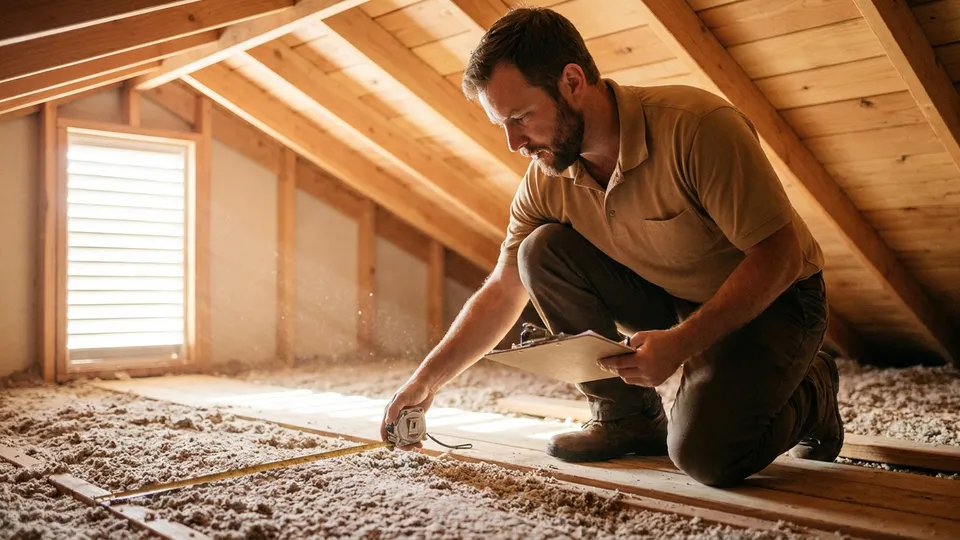
Insulating a whole house in San Diego County typically costs $4,500 to $14,000, depending on square footage, which areas you’re doing, and the materials involved. Most single-family homes in the 1,500 to 2,500 sq ft range land between $6,000 and $10,000 for a complete attic, wall, and air-sealing scope. Utility rebates can trim that when programs are active, though the big federal 25C tax credit expired for installs after 2025.
This post covers the full picture: cost by area of the house, cost by home size, cost by material, and what rebates do to the final number. If you’re only doing the attic, we have a dedicated breakdown at attic insulation cost breakdown. If spray foam is part of the scope, the detailed spray foam pricing is at detailed spray foam pricing.
Cost by area of the house
Every part of the building envelope has a different cost structure. Here’s what each area typically runs in San Diego.
Attic
Attic insulation is the highest-return area and usually the first scope tackled. For a 1,500 to 2,000 sq ft footprint, blown-in cellulose or fiberglass to R-49 runs $2,500 to $4,500. Spray foam at the roofline costs more: $5,500 to $13,000 depending on product. Air-sealing before blowing is the right sequence, that’s covered separately in our air-sealing guide.
Walls
Existing exterior walls are the hardest area to improve without a full remodel. Retrofit options are limited to dense-pack blown-in (cellulose or fiberglass through drilled holes) or injection foam. Expect $1.50 to $3.50 per square foot of wall area for dense-pack, which on a 1,800 sq ft single-story home works out to roughly $3,500 to $7,000 for all exterior walls. New construction or open-wall remodels use batts at $0.50 to $1.20 per square foot installed, much cheaper when the cavity is already accessible.
Crawlspace
Crawlspace work in San Diego most often means insulating the floor above (R-19 to R-30 batts or blown-in), vapor-sealing the ground, and sometimes insulating the perimeter walls for a conditioned crawl. Floor insulation on a 1,000 sq ft crawlspace runs $2,000 to $4,500. A full encapsulation with perimeter insulation adds $2,000 to $5,000 on top of that. More detail at crawlspace insulation.
Garage
An attached garage that shares a wall or ceiling with living space is worth addressing. Insulating the shared wall and ceiling (not the exterior-facing walls, which have minimal return in San Diego’s climate) typically costs $800 to $2,200 depending on size and whether drywall needs to be disturbed.
Air sealing
Air sealing is usually quoted as part of an attic or whole-house scope rather than a standalone line item, but the labor and materials add $400 to $1,500 to a job depending on how many penetrations, top plates, and duct boots need attention. It’s consistently the highest ROI item on the whole list.
Whole-house cost by home size
These estimates assume a complete scope: attic to R-49, exterior walls dense-packed, crawlspace floor insulated to R-19, and air-sealing throughout. They use blown-in cellulose for attic and walls (not spray foam). Spray foam scopes run roughly 1.5 to 2.5x these numbers.
| Home size | Attic + air seal | Add walls | Add crawlspace | Full scope |
|---|---|---|---|---|
| Under 1,200 sq ft | $2,200, $3,800 | $2,500, $4,500 | $1,500, $2,800 | $6,200, $11,100 |
| 1,200, 1,800 sq ft | $2,800, $4,500 | $3,200, $5,800 | $1,800, $3,500 | $7,800, $13,800 |
| 1,800, 2,500 sq ft | $3,500, $5,500 | $4,000, $7,000 | $2,200, $4,500 | $9,700, $17,000 |
| 2,500, 3,500 sq ft | $4,500, $7,000 | $5,500, $9,000 | $2,800, $5,500 | $12,800, $21,500 |
These are installed ranges including material, labor, and standard cleanup. They don’t include insulation removal, which adds $1.50 to $3 per square foot if old material has to come out first.
Cost by material
Material choice matters a lot at the whole-house scale. Here’s how the common options compare:
| Material | Typical R per inch | Best use | Cost range per sq ft installed |
|---|---|---|---|
| Blown-in fiberglass | R-2.2 to R-2.7 | Attic top-up | $1.00, $1.80 |
| Blown-in cellulose | R-3.2 to R-3.8 | Attic, dense-pack walls | $1.10, $2.00 |
| Fiberglass batts | R-3.1 to R-3.7 | Open walls, crawlspace floors | $0.50, $1.20 |
| Mineral wool batts | R-3.7 to R-4.2 | Open walls, sound priority | $1.00, $1.80 |
| Open-cell spray foam | R-3.6 to R-3.9 | Rooflines, cathedral ceilings | $1.80, $3.00 |
| Closed-cell spray foam | R-6.0 to R-7.0 | Rooflines, moisture-critical | $3.00, $5.50 |
| Injection foam | R-4.0 to R-4.6 | Retrofit walls (no drill patch) | $2.50, $4.50 |
For most whole-house projects in San Diego, blown-in cellulose in the attic combined with dense-pack cellulose in walls is the most cost-effective path. Spray foam makes sense for specific assemblies, unvented rooflines, conditioned attic conversions, and below-grade or moisture-exposed areas. See spray foam vs cellulose if you’re weighing those two for your scope.
What zone you’re in affects the cost case (not always the price)
San Diego County spans four Title 24 climate zones. The work itself costs roughly the same per square foot regardless of zone. What changes is how much return you get.
Zone 7 (coastal: Del Mar, Coronado, Imperial Beach) has mild temperatures year-round. The savings case is more about comfort and moisture control than raw energy cost. Zone 10 (inland valleys: Escondido, El Cajon) sees hotter summers and cooler winters, so the ROI is sharper. Zone 14 (desert-facing east county) and Zone 15 (low desert fringe toward Ocotillo) get the most benefit from good attic and wall insulation.
If you’re not sure which zone applies to your address, our insulation calculator can help you estimate payback based on your location and scope.
How SDG&E rebates change the net cost
SDG&E’s insulation rebates reduce the upfront cost directly. The program’s specifics and current rebate amounts are detailed at the SDG&E insulation rebates guide, but the short version: rebates typically run $0.10 to $0.25 per square foot for attic insulation meeting program requirements, with additional amounts for air sealing. On a 2,000 sq ft attic scope, that’s $200 to $500 back.
The rebates are utility-funded and subject to budget caps, they’re real but modest.
What happened to the 25C tax credit
The 25C energy-efficiency credit used to cover 30 percent of insulation and air-sealing costs, up to $1,200 per year. Congress ended it for property placed in service after December 31, 2025, so insulation installed in 2026 doesn’t qualify. If your job was completed in 2025, you can still claim the credit on your 2025 federal return; you’ll need the manufacturer’s certification statement and an itemized invoice, both of which Thermal Pro provides.
For 2026 projects, budget on the sticker price minus whatever SDG&E rebate is active when you book. Tax law changes, so confirm the current federal picture with a tax professional at quote time rather than trusting any contractor’s marketing page, including ours.
What’s not included in these ranges
A few things add to the base cost and are worth knowing before you get a quote:
Insulation removal. If your existing attic insulation is rodent-fouled, contains mold, or is suspected vermiculite (asbestos-containing material common in pre-1980 homes), it has to come out before anything new goes in. That’s a separate scope. See insulation removal for what removal involves.
Drywall repair after wall work. Dense-pack wall jobs require drilling small holes in the exterior or interior surface, then patching them. That’s typically included in the quote, but confirm before signing.
HVAC duct sealing. Leaky ducts undermine even excellent insulation. Duct sealing is a separate service and is often recommended alongside a whole-house insulation project.
Getting to a real number for your home
The ranges in this post are honest starting points, not quotes. The actual cost for your home depends on attic access conditions, wall construction type, whether old insulation has to come out, and the specific R-values you’re targeting.
The best first step is a free in-home assessment. We measure what you have, identify where air is moving that shouldn’t be, and give you a written scope before you commit to anything. Call us at (858) 925-5546 or reach out through our contact page to schedule one.