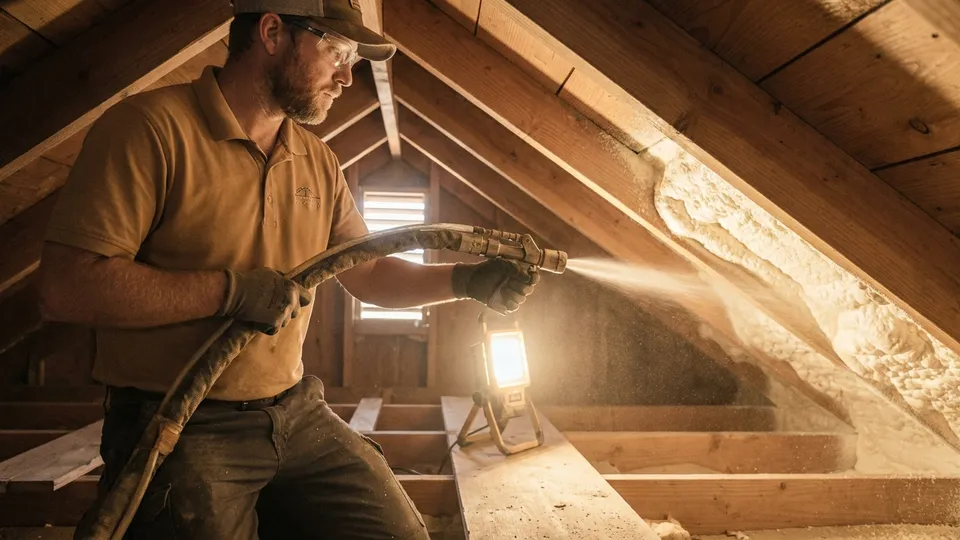
Open-cell spray foam runs about R-3.7 per inch. Closed-cell spray foam runs R-6 to R-7 per inch. That gap drives almost every other difference between them, including cost, moisture performance, and where each one belongs in a San Diego home. The short answer: closed-cell wins wherever moisture or structural strength matters, and open-cell wins in walls and vaulted ceilings where budget and breathability matter more.
What makes them different
Both types start as two-part liquid chemicals that react on contact and expand to fill gaps. That’s where the similarity ends.
Open-cell foam expands dramatically, up to 100 times its liquid volume. The resulting material is soft and spongy, with a mostly open cellular structure that lets air and some vapor pass through. It costs less to produce and installs faster. At 3.5 inches (a standard 2x4 wall cavity), it delivers about R-13.
Closed-cell foam expands less, typically 30 to 40 times its volume, and cures into a rigid, dense material. The cells are sealed, which makes it impermeable to both air and moisture. At 2 inches, it hits roughly R-12 to R-14. At 3 inches, you’re at R-18 or better. It also adds measurable structural rigidity to walls and roof decks.
R-value and thickness in real San Diego applications
California Title 24 sets the floor for insulation in new construction and remodels. In San Diego’s coastal zone 7, attic insulation typically needs to hit R-38 minimum. Inland zones 10, 14, and 15 push that to R-49 in many configurations.
| Location | Open-cell (needed inches) | Closed-cell (needed inches) | Notes |
|---|---|---|---|
| Attic roof deck (zone 7) | ~10 in. for R-38 | ~6 in. for R-38 | Closed-cell leaves more headroom |
| 2x4 wall cavity | 3.5 in. fills cavity (R-13) | 2 in. fills half, R-12 | Hybrid approach common |
| 2x6 wall cavity | 5.5 in. fills cavity (R-20) | 3 in. (R-18), 5.5 in. (R-33+) | Over-insulating is possible with closed |
| Crawlspace rim joist | 3-4 in. (R-11 to R-15) | 2-3 in. (R-12 to R-18) | Closed preferred for moisture |
| Crawlspace floor/walls | Not recommended | 2-3 in. standard | Vapor control critical |
Neither type requires you to hit maximum thickness everywhere. In San Diego’s mild, cooling-dominated climate, the payoff from overshooting R-38 in most attics is modest. The better investment is often sealing every air gap before worrying about adding R-value, which is why air sealing and insulation typically go together.
Moisture and vapor: where San Diego’s coastal climate matters
San Diego has a mild climate, but coastal areas from Point Loma to Encinitas to Chula Vista deal with marine-layer humidity that penetrates crawlspaces and framing cavities. This is where the open/closed distinction matters most.
Open-cell foam is vapor-permeable. In most wall assemblies, that’s fine. The assembly can dry to the inside. But in a crawlspace or on a low-slope roof deck, vapor-permeable insulation can trap moisture against wood framing. Over time, that causes problems.
Closed-cell foam acts as a Class II vapor retarder. At 2 inches or more, it slows vapor movement enough to protect wood framing in damp environments. For crawlspace rim joists and unvented roof decks in coastal zip codes, closed-cell is the better call, even with a higher upfront cost.
Open-cell is generally fine in walls, vaulted ceilings, and conditioned attics in San Diego’s inland zones where outdoor relative humidity is lower.
Cost per board foot: what to budget
Spray foam pricing varies by market and job complexity. These are typical installed ranges in San Diego County.
| Type | Installed cost per board foot | Relative comparison |
|---|---|---|
| Open-cell | $0.44, $0.65 | Lower cost per board foot |
| Closed-cell | $1.00, $1.50 | Higher cost per board foot |
A board foot is one square foot at one inch thick. To fill a 500 sq. ft. attic roof deck at 6 inches with closed-cell, that’s 3,000 board feet, roughly $3,000 to $4,500 in material and labor. The same area with open-cell at 10 inches (for comparable R-38) is 5,000 board feet, roughly $2,200 to $3,250. Closed-cell uses fewer inches to hit the same R-value, which partially offsets its higher per-board-foot price.
For a detailed cost breakdown by project type, see our post on spray foam insulation cost in San Diego. This post focuses on the material comparison, not the full pricing picture.
Where each type wins in San Diego
Open-cell wins in
Walls (2x4 and 2x6 cavities). Open-cell fills the full cavity in one pass, costs less, and delivers good R-value for a standard wall assembly. It also blocks air movement effectively, which matters as much as R-value in practice.
Vaulted and cathedral ceilings. Where you have limited rafter depth and need to fill the cavity, open-cell is often more economical. It won’t trap moisture in a well-ventilated assembly.
Interior sound control. Open-cell’s soft structure absorbs sound better than closed-cell. For interior walls between a bedroom and a garage or home theater, open-cell is the common choice.
Conditioned attics (inland zones). In zone 10 (El Cajon, Santee, Alpine area) where you’re converting an attic to conditioned space and moisture isn’t a primary concern, open-cell can be cost-effective on roof deck applications.
Closed-cell wins in
Unvented attic roof decks (coastal zones). When you spray the underside of the roof sheathing to create a conditioned attic, closed-cell at the right thickness controls vapor and adds structural rigidity. In coastal zones 7, moisture control is a real factor.
Crawlspace rim joists. This is one of the best uses of closed-cell in a San Diego home. Rim joists sit right above the foundation, often right at ground level. They’re exposed to soil moisture and outside air. A 2- to 3-inch application of closed-cell seals the air and handles the moisture in one step. See our dedicated page on crawlspace insulation.
Low-slope roofs and unvented assemblies. Flat or low-slope roofs on additions and detached garages often get closed-cell on the roof deck for vapor control and compressive strength.
Garage ceilings with living space above. If there’s a bedroom above the garage, closed-cell’s vapor control and structural rigidity make it the right choice in most configurations.
Partial fills (flash-and-batt). A common hybrid approach uses 1 to 2 inches of closed-cell on the exterior face of a wall cavity for air and vapor control, then fills the rest with fiberglass batts. This delivers closed-cell’s vapor-barrier benefit at a lower total cost than filling the whole cavity with closed-cell.
The decision table
| Factor | Open-cell | Closed-cell |
|---|---|---|
| R-value per inch | ~R-3.7 | R-6 to R-7 |
| Air barrier | Yes | Yes |
| Vapor barrier | No | Yes (at 2+ in.) |
| Structural rigidity | Minimal | Adds rigidity |
| Cost per board foot | Lower | Higher |
| Best for walls | Yes | Flash-and-batt hybrid |
| Best for crawlspace rim joists | No | Yes |
| Best for unvented roof decks (coastal) | Conditional | Yes |
| Best for sound control | Better | Lower performance |
| Best for inland dry climates | Yes | Yes (where budget allows) |
How this compares to other insulation types
Spray foam, whether open or closed, outperforms most materials on air sealing. That’s often the biggest performance driver in an older San Diego home with gaps around plumbing, wiring penetrations, and leaky framing connections. Blown-in cellulose and fiberglass add R-value but don’t seal gaps the way foam does.
If you’re weighing foam against blown-in options, our comparison of spray foam vs. cellulose in San Diego goes deeper on that specific question.
For understanding how R-value actually translates to energy performance in San Diego’s climate zones, see our guide on R-value explained for San Diego homes.
Financial considerations
The federal 25C tax credit expired for installs after December 31, 2025, so neither foam type earns a federal credit on new work. SDG&E does offer insulation rebates that apply to qualifying projects. Incentives don’t change which foam is right for your application, but an active rebate can trim out-of-pocket cost on either type; confirm what’s available at quote time.
Getting the right call for your home
Most San Diego homes don’t need a single foam type throughout. The right approach usually mixes open-cell in walls and vaulted ceilings with closed-cell on rim joists and any moisture-exposed assemblies. The exact mix depends on your home’s framing, ventilation configuration, and what you’re trying to solve.
Thermal Pro San Diego works across the full county, from coastal Encinitas and Chula Vista to inland El Cajon and Escondido. If you’d like a straight assessment of which foam makes sense where, reach out through our contact page or call us at (858) 925-5546. No sales pitch, just a look at what your home actually needs.