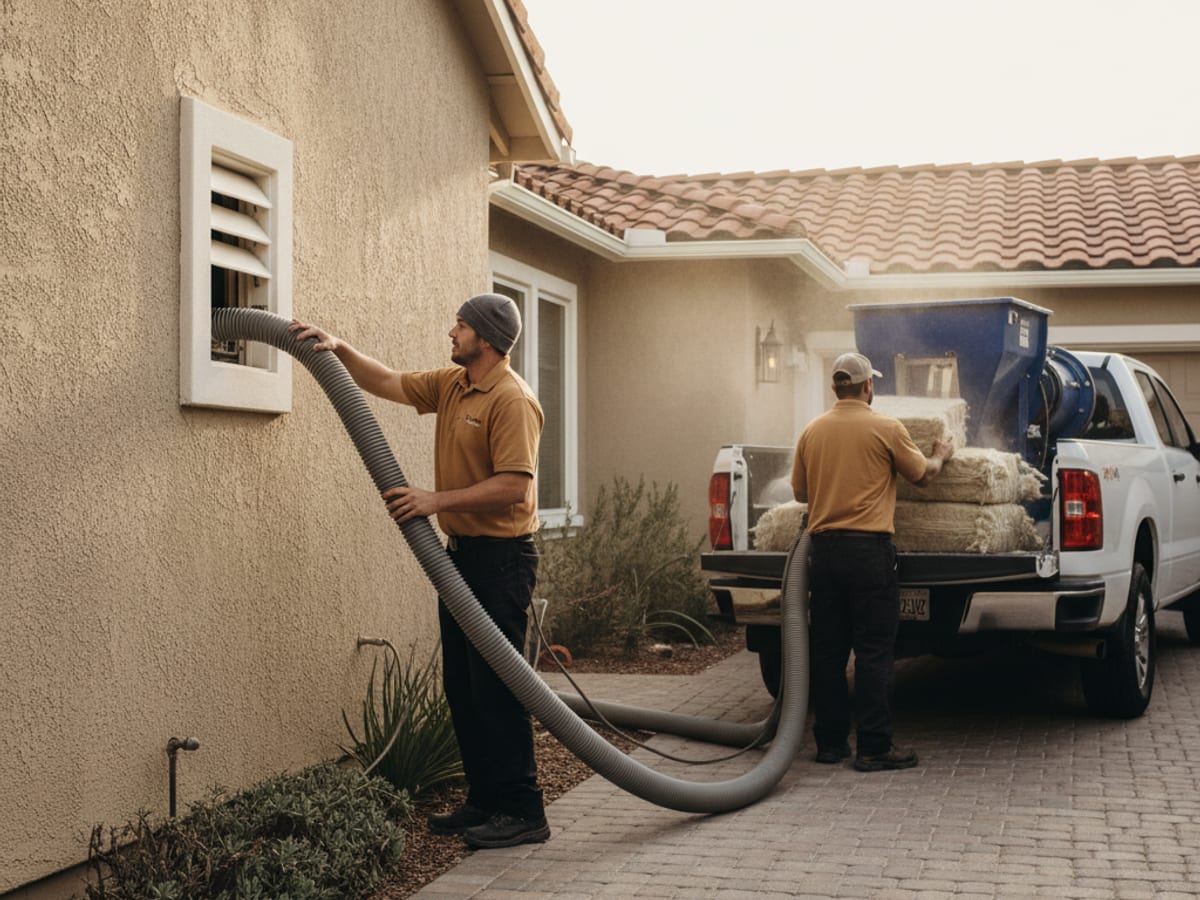
Blown-in insulation is loose-fill material, cellulose or fiberglass, blown through a hose to fill your attic floor evenly. In San Diego it runs about $1.40 to $2.80 per square foot installed, so $2,500 to $4,500 for most 1,500 to 2,000 sq ft homes. It’s the standard fix for an under-insulated attic because it fills the gaps batts miss. Here, the goal is keeping heat out, not keeping heat in.
Why San Diego is a cooling problem, not a heating one
Most insulation advice online is written for cold states. It talks about holding furnace heat inside through winter. That’s backwards for us.
San Diego barely heats. We cool. Your attic bakes in the afternoon sun, the heat radiates down through the ceiling, and your AC fights it all day. Inland, that’s the whole battle. So when blown-in insulation goes in, it slows heat coming down in summer, not heat escaping up in winter.
This changes what matters. Even coverage beats raw thickness. Air-sealing the ceiling matters as much as the insulation itself. And a radiant barrier often pays off here when it wouldn’t in Minnesota. We cover that in radiant barriers for East County homes.
Cellulose vs fiberglass: which loose-fill
Both get blown the same way. The difference is the material.
Cellulose is recycled paper treated with borate for fire and pests. Higher R per inch (about R-3.5), denser, and it resists air movement better. That density helps in our climate because it slows the slow drift of hot attic air down through the ceiling. Our default for most San Diego attics.
Fiberglass is spun glass, lighter, non-organic, around R-2.5 per inch. We reach for it where past moisture or a humid coastal crawlspace makes an organic material a bad bet. It won’t feed mold and it won’t settle as much over time.
Cost difference is small, usually a couple hundred dollars on a typical attic. The choice is about conditions, not budget.
What it costs in San Diego County
These are blown-in, top-up scope on an attic that already has some old insulation, going up to R-49 with cellulose:
| Home size | Existing R-value | Installed cost |
|---|---|---|
| 1,200 sq ft | R-13 | $2,000 to $3,200 |
| 1,500 sq ft | R-19 | $2,500 to $4,200 |
| 2,000 sq ft | R-13 | $3,200 to $5,000 |
| 2,500 sq ft | low or none | $4,200 to $6,500 |
Empty attics start 15 to 20 percent higher because we lay baffles and start from scratch. A rodent-fouled or water-damaged attic needs removal first, another $1.50 to $3 per square foot. See when insulation removal is actually needed before you assume you need it.
R-value targets by your climate zone
California splits San Diego County into three Title 24 climate zones, and your target R-value follows the zone.
Zone 7 (coastal: downtown, Coronado, Chula Vista, National City). Mild marine air, smallest temperature swings. Code minimum is R-30 on a roof alteration, R-38 on a full reinsulation. R-38 is plenty for most coastal homes.
Zone 10 (inland valleys: El Cajon, Santee, Escondido, San Marcos). Hotter summers, real attic heat. We target R-49 here. The jump from R-38 to R-49 costs about 20 percent more material and the afternoon comfort difference is obvious.
Zone 14 (desert edge: backcountry past the mountains). Extreme summer heat. R-49 minimum, R-60 worth considering.
We walk through all of this in R-value by climate zone and the Title 24 requirements for San Diego.
How much you actually save
Blown-in insulation pays for itself slowest at the coast and fastest inland. A coastal home that’s already comfortable sees a modest SDG&E bill drop. An El Cajon or Santee home going from old R-13 to R-49 often cuts summer cooling cost by 20 to 30 percent, because that’s where the attic heat is brutal and the AC runs hardest.
Add air-sealing the ceiling plane first and the numbers improve again. Insulation slows heat; air-sealing stops it leaking through gaps. Doing one without the other leaves money on the table. Here’s why air-sealing comes before insulation.
SDG&E rebates can offset the cost
SDG&E and California efficiency programs offer rebates on qualifying attic insulation upgrades, and they change year to year. We help you find what’s current and handle the paperwork so the credit actually lands. We laid out the live programs in the 2026 SDG&E insulation rebates guide. Always check eligibility before the job, not after.
How a blown-in job actually goes
A clean top-up on a walkable attic is a half-day. Here’s the order:
- Inspect and measure existing depth, check for moisture, pests, and gaps.
- Air-seal the ceiling plane: can lights, top plates, plumbing and wiring penetrations.
- Set baffles at the eaves so soffit venting stays open.
- Mark target depth on the rafters so coverage is verifiable.
- Blow the loose-fill evenly to the marked depth.
- Photograph depth at multiple points so you can see you got the rated R-value.
That depth-marking step matters. Bag count alone doesn’t prove R-value. Settled or thin spots do the opposite of what you paid for.
Frequently asked questions
Is blown-in better than batts? For attic floors, usually yes. Loose-fill flows around wiring, joists, and odd framing that batts have to be cut around, and those cuts leave gaps. Batts still make sense in open walls and some specific assemblies.
Will it settle over time? Cellulose settles slightly in the first year, which is why a good installer blows to a depth that accounts for it. Fiberglass settles less. Both hold their rated R-value when installed to the right depth.
How much R-value do I need in San Diego? Depends on your climate zone. R-38 covers most coastal homes, R-49 is the inland target, and R-60 is worth it only at the desert edge. Cold-climate advice telling you R-60 everywhere doesn’t fit here.
Can blown-in go on top of my old insulation? Yes, if the old material is dry, pest-free, and not vermiculite. The crews we send blow right over good existing insulation to add depth. If it’s fouled or wet, it comes out first.
Does it help with cooling or just heating? Cooling, mostly, in our climate. It slows attic heat from radiating down into your living space, which is the main comfort and bill problem in San Diego.
Do I qualify for an SDG&E rebate? Often, if your attic is under-insulated and you upgrade to a qualifying R-value. Programs change, so we check current eligibility before we quote.
Get a straight quote
We give upfront, flat-rate quotes on blown-in insulation across San Diego County, coast to backcountry. No vague per-bag pricing, no upsell games. We’ll tell you your climate zone, the right R-value target, and whether a rebate applies before you commit. See the full blown-in insulation service or call us at (858) 925-5546 and we’ll walk your attic.