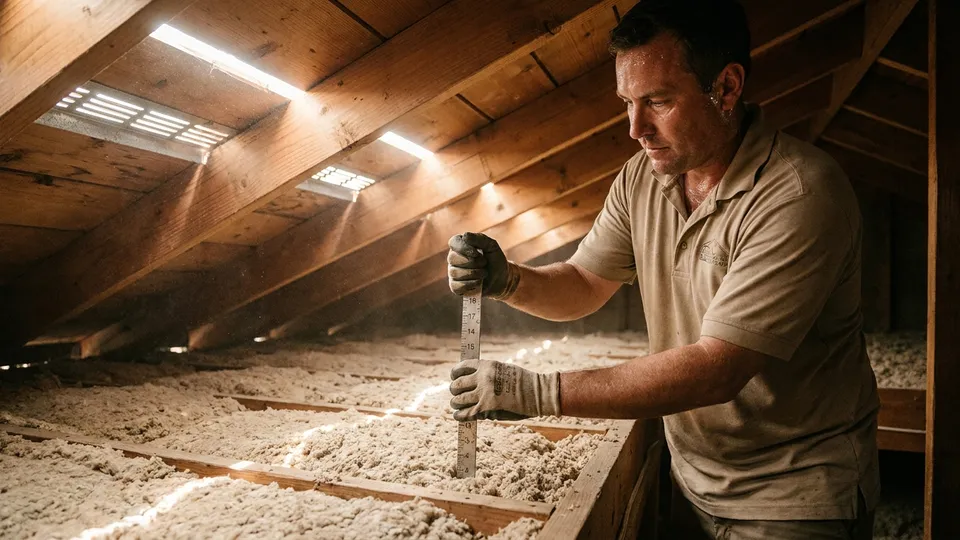
Yes, attic insulation helps with cooling in San Diego. Most homes here lose 20-30 percent of their cooling through an under-insulated attic. After upgrading from R-11 to R-38 or higher, homeowners typically see summer AC bills drop 10-20 percent, sometimes more in inland zones. That’s a real number, not a sales pitch. What you actually save depends on what you have now, where you live in the county, and whether you address air leaks at the same time.
Why the attic drives your cooling bill
San Diego isn’t Phoenix. But attics here still get brutally hot in summer, particularly inland. On a 90°F day in El Cajon or Santee, attic temperatures reach 140-160°F. In coastal San Diego, the marine layer keeps things cooler, but attics still hit 110-130°F on warm afternoons.
That heat moves into your living space through two pathways:
Conduction is heat moving through the insulation material itself. A poorly insulated attic floor lets that 140°F heat push steadily into the ceiling below it. R-value measures resistance to this.
Radiation is heat moving through air as infrared energy. The hot roof decking radiates heat downward, warming the attic air and anything in it, including your HVAC ducts. If your ducts run through the attic, they’re baking in that heat before conditioned air ever reaches your rooms.
Both pathways add load to your AC. Fixing both is how you get the higher end of the savings range.
What realistic savings look like
Here’s an honest table. Figures are typical ranges for San Diego County homes, not best-case scenarios. Actual savings vary by home size, duct condition, thermostat behavior, and SDG&E rate tier.
| Current R-value | Upgraded to | Estimated cooling-bill reduction |
|---|---|---|
| R-11 or less | R-38 | 12-22% |
| R-11 or less | R-49 | 15-25% |
| R-19 | R-38 | 8-15% |
| R-19 | R-49 | 10-18% |
| R-30 | R-38 | 4-8% |
| R-30 | R-49 | 5-10% |
| R-38 | R-49 | 2-5% (diminishing returns) |
The jump from nothing to code-minimum is where the money is. Going from R-38 to R-49 is worth doing, but don’t expect a dramatic monthly change on the bill. If you’re already at R-38 and want to cut more, air-sealing and duct work are where to look next.
For climate zone context: California Title 24 sets R-38 as the minimum target for most of San Diego County’s coastal and inland zones. East County and the desert fringe (zones 14 and 15) target R-49. If your home was built before 2010, it very likely falls short of current standards.
The three-part system that actually works
Insulation alone does a solid job. Insulation combined with air-sealing and a radiant barrier does a noticeably better job, and that’s not upselling. Here’s why each piece matters.
R-value: slowing conductive heat
Attic insulation is your primary defense against conducted heat. The most common upgrade we do in San Diego is blown-in cellulose or fiberglass on top of old batt insulation that’s settled and degraded. It’s fast, cost-effective, and the results are consistent.
The target for most San Diego homes is R-38 to R-49. To understand how climate zone affects that target, the r-value guide for San Diego breaks it down by zone.
Air-sealing: stopping the leaks insulation can’t
Insulation slows conduction. It does nothing for air leaks. And attics leak a lot: around recessed lights, top plates, attic hatches, plumbing and electrical penetrations. Hot attic air pours through those gaps directly into conditioned space.
We almost always recommend air-sealing before or alongside an insulation upgrade. Doing insulation first and sealing later means disturbing the new material. The case for air-sealing before insulation explains the order and why it matters.
In coastal San Diego homes, air-sealing often delivers a bigger summer comfort improvement than the insulation upgrade itself, because coastal attics aren’t hot enough for radiation to dominate the heat gain picture.
Radiant barrier: cutting the heat at the source
A radiant barrier is foil stapled to the underside of your roof rafters. It reflects 90-97 percent of the infrared radiation coming off the hot roof deck before it can heat up the attic air and your HVAC ducts.
In coastal zones, radiant barrier is usually a lower-priority upgrade. The attic doesn’t get hot enough for radiation to be the main driver. In East County, inland valleys, and the desert fringe, it’s worth doing alongside the insulation. Attic temps drop 20-30°F. The AC doesn’t have to work as hard in the afternoon when the cooling load peaks.
The radiant barrier breakdown for East County covers when foil actually pays back and when it doesn’t, so you’re not spending money on an upgrade that won’t move your bill.
Payback timing in San Diego
San Diego electricity rates are among the highest in the country. That’s actually good news for payback math: higher rates mean every kilowatt-hour you save is worth more.
A typical attic insulation project for a 1,500-2,000 sq ft San Diego home runs $2,000-$4,500 depending on current conditions and upgrade target. The federal 25C tax credit expired for installs after December 31, 2025, so don’t count it in 2026 math. SDG&E does periodically offer insulation rebates that trim out-of-pocket costs; confirm what’s active at quote time.
If your cooling bill drops $25-$50 per month on a $3,000 project, you’re looking at a 5-10 year payback, with energy savings continuing for 20+ years after that.
For homes at R-11 or less in inland zones, payback comes fastest. For homes upgrading from R-30 to R-49 in a coastal zone, it stretches toward the 10-year end. Both are reasonable. Neither is a gamble.
You can run your own numbers with the insulation savings calculator.
Zone-by-zone summary
| San Diego climate zone | Typical summer attic temp | Best first upgrade | Radiant barrier worth it? |
|---|---|---|---|
| Zone 7 (coastal) | 105-125°F | Air-sealing + insulation | Usually not first priority |
| Zone 10 (inland valleys) | 125-145°F | Insulation to R-38-49 | Yes, if ducts in attic |
| Zone 14 (east county) | 140-160°F | Insulation + radiant barrier | Yes, high return |
| Zone 15 (desert fringe) | 150-165°F | All three together | Yes, strong return |
Most San Diego homes fall in zones 7 and 10. East County and the mountain communities sit in zones 14 and 15 where the full combination of insulation, air-sealing, and radiant barrier earns the strongest return.
Common questions
Does attic insulation help if I have a newer home? It depends on when it was built and what was installed. Homes from the 1980s and 1990s often have R-11 to R-19 in the attic, well below current standards. Even homes built in the 2000s sometimes have insulation that has settled or been disturbed by HVAC or electrical work. A quick measurement during an assessment tells you where you actually stand.
What about spray foam in the attic? Closed-cell spray foam on the roof deck turns the attic into conditioned space, a good solution but a different approach with a higher upfront cost. It’s worth considering if your HVAC equipment is in the attic and you want to bring everything inside the thermal envelope. For most standard attic upgrades, blown-in is more cost-effective.
Will insulation help with upstairs rooms that never cool down? Usually, yes. Rooms on the top floor suffer most from attic heat gain. After insulation and air-sealing, those rooms typically stabilize faster and hold set-point temperature better. If the problem persists after insulation, duct condition is the next thing to check.
Get an honest assessment
If you’re not sure what you have or what your home actually needs, we’ll come out and measure it. Free in-home estimate, no pressure. We’ll tell you the current R-value, where the air leaks are, and what combination of upgrades makes financial sense for your zone.
Call (858) 925-5546 or schedule online.