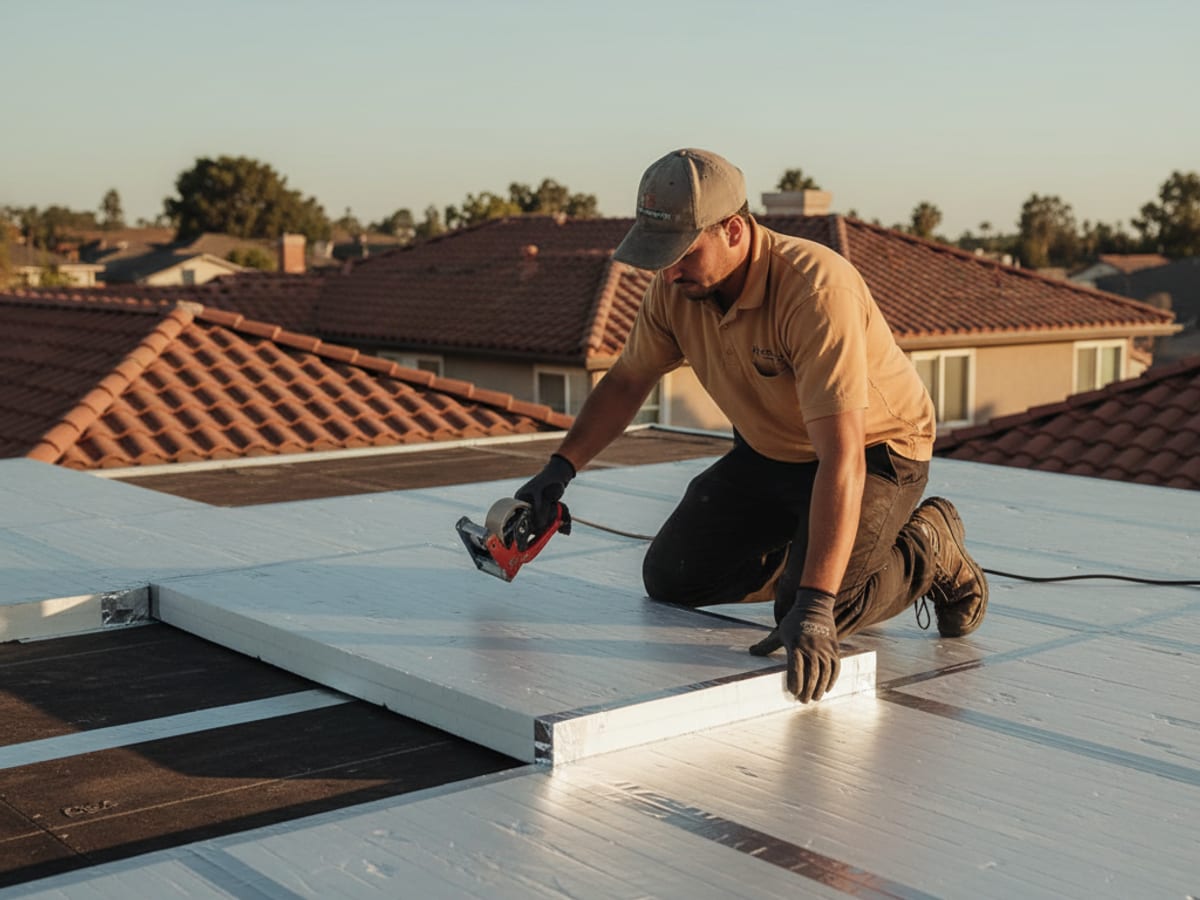
Rigid foam insulation is dense board insulation made from EPS, XPS, or polyiso. It comes in 4-by-8 sheets and goes on roof decks, foundation walls, and the outside of stud walls as continuous insulation. In San Diego, its best use is stopping conducted heat that batts and blown-in can’t reach: the studs, the roof deck, and concrete. It costs more per R-value than blown-in, so we use it where it earns the premium.
The three types, and which one to buy
There are three rigid foams. They look similar and price very differently.
EPS (expanded polystyrene) is the white beaded board. It gives R-3.6 to R-4.4 per inch and costs the least, roughly $0.25 to $0.35 per board foot of material. It’s the value play, and it holds its R-value over time instead of drifting.
XPS (extruded polystyrene) is the pink or blue board. It runs R-4.5 to R-5.0 per inch at about $0.40 to $0.50 per board foot. It handles moisture well, which is why it’s the standard under slabs and against foundation walls. Its one knock is thermal drift: the R-value drops slightly over years as gas escapes.
Polyiso (polyisocyanurate) is the foil-faced board. It’s the highest performer at R-5.6 to R-6.5 per inch, usually $0.70 to $2.00 per square foot for a 1-inch panel. The foil facing adds a radiant barrier, which matters a lot in a San Diego attic. It also drifts, so always compare polyiso using its LTTR number, not its fresh-off-the-truck rating. We cover that in our R-value guide.
For most San Diego exterior-wall and roof-deck jobs, polyiso wins on R-per-inch and the radiant facing. For below-grade and slab work, XPS wins on moisture. EPS wins when budget is the deciding factor and the wall isn’t getting wet.
What it actually costs installed
Material price is only half the story. Here’s what rigid foam runs installed in San Diego County.
| Application | Typical R-value | Installed cost |
|---|---|---|
| Exterior wall continuous insulation (1 in.) | R-5 to R-6.5 | $2.25 to $3.75 per sq ft |
| Roof deck over an attic (2 in. polyiso) | R-11 to R-13 | $4.50 to $7.00 per sq ft |
| Foundation / below-grade wall (2 in. XPS) | R-9 to R-10 | $3.00 to $5.00 per sq ft |
| Slab edge (1 in. XPS) | R-5 | $2.00 to $3.50 per sq ft |
These are real ranges, not teaser numbers. The spread depends on board thickness, how much trim and flashing the job needs, and whether siding comes off. We quote the full number up front, including the fasteners and tape that a lot of bids quietly leave out.
Why rigid foam matters in a cooling climate
San Diego is cooling-dominated. We run the AC far more than the heat. That changes which insulation work pays off.
Most of the unwanted heat in an inland home in El Cajon, Santee, or Escondido comes through the roof and the sunny walls in summer afternoons. Blown-in attic insulation slows the heat that already entered the attic. Rigid foam on the roof deck or the exterior walls stops a chunk of it from getting in at all. Foil-faced polyiso on the roof deck does double duty: it insulates and it reflects radiant heat off the underside of the roof, which is the same idea behind a radiant barrier but built into the board.
Coastal zones like La Jolla, Encinitas, and Point Loma stay mild thanks to the marine layer, so the load is lighter. But the afternoon sun still bakes a west-facing wall in Clairemont or Mira Mesa. Continuous rigid foam on those walls cuts the heat that pours through the studs, which a cavity-only wall can’t stop.
The thermal bridge problem rigid foam solves
This is the reason rigid foam exists, and most homeowners never hear it.
Your wall studs are wood. Wood is about R-1.25 per inch, far worse than the insulation in the cavity between studs. Studs sit every 16 inches, so roughly a quarter of your wall is a low-R wood path that heat flows straight through. That drops your real “whole-wall” R-value 10 to 20 percent below the number on the insulation bag.
Rigid foam on the outside of the studs covers that wood path with a continuous unbroken layer. Heat can’t shortcut through the framing anymore. This is called continuous insulation, and it’s now standard on high-performance new builds for exactly this reason. On a remodel where the siding is already coming off, adding an inch of foam underneath is the single best upgrade you can make to an exterior wall.
How rigid foam fits Title 24
California’s energy code, Title 24, sets minimum R-values by climate zone, and San Diego County spans three: zone 7 on the coast, zone 10 inland, and zone 14 in the desert east. Newer code editions increasingly call for continuous exterior insulation on certain wall assemblies, not just cavity insulation, precisely because of the thermal bridge.
If you’re adding a room, re-siding, or doing a deep remodel, rigid foam is often how you hit the code wall number without thicker framing. We’ll tell you whether your project triggers a continuous-insulation requirement before you commit to a wall design, so there’s no surprise at inspection.
When rigid foam is the wrong call
We don’t sell foam where it doesn’t belong. Three honest cases where it’s not the answer:
Filling an open attic floor. Blown-in cellulose or fiberglass costs a quarter as much per R-value and fills the irregular space better. Rigid foam belongs on the deck, not loose on the floor.
Empty existing wall cavities. If the studs are closed up and the cavity is empty, dense-pack blown-in through small drilled holes is far cheaper than tearing off siding to add foam.
Tight budgets where the wall stays dry and the siding stays on. The labor to add exterior foam is real. Sometimes air-sealing plus a good attic top-up gives you more comfort per dollar.
Rebates that apply
Some insulation upgrades qualify for SDG&E rebates, and continuous insulation that meaningfully improves your envelope can count depending on the program and the year. The programs change, so we keep current on what’s active. See our SDG&E rebate guide for the latest, and we’ll fold any eligible rebate into your quote so the number you see is the number after savings.
Frequently asked questions
Is rigid foam better than spray foam? They do different jobs. Rigid foam is a board you fasten to a flat surface like a roof deck or exterior wall. Spray foam expands to fill irregular cavities and odd gaps. For continuous exterior insulation, rigid board is cleaner and cheaper. For filling a vaulted ceiling or rim joist, spray foam fits where board can’t.
Which rigid foam is best for a San Diego attic? Foil-faced polyiso on the underside of the roof deck. It gives the highest R-per-inch and the foil reflects radiant heat, which is most of the summer attic problem inland. For a vented attic, though, blown-in on the floor is usually the better value.
Can rigid foam get wet? XPS and EPS shrug off moisture, which is why XPS is the standard below grade and at slabs. Polyiso’s foil facing resists water but the core can absorb it, so we keep polyiso out of below-grade and wet applications.
Does rigid foam need a fire barrier? Yes. When rigid foam is installed on an interior surface like a garage or basement wall, code requires a thermal barrier over it, usually half-inch drywall. We handle that detail so the install passes inspection.
How thick does the foam need to be? It depends on the target R-value and the climate zone. One inch of polyiso gets you about R-6, which covers a lot of continuous-insulation requirements. Thicker boards or doubled layers hit higher targets. We size it to your assembly and your Title 24 zone.
Will rigid foam lower my AC bill? In a cooling-dominated climate like ours, stopping heat at the roof deck and the sunny walls is exactly where the savings come from. The bigger the summer sun load on your home, the more continuous foam pays back.
Talk it through with someone local
Rigid foam is the right tool for specific jobs: roof decks, exterior walls, foundations, and slabs. It’s the wrong tool for filling open attics and closed cavities. The trick is matching the product to the assembly and your climate zone, and that’s a 10-minute conversation, not a guessing game.
We serve all of San Diego County, give you the full installed number up front, and help with Title 24 and SDG&E rebate questions along the way. You can see the full scope on our rigid foam insulation service page, or just call us at (858) 925-5546 and tell us what you’re working on.