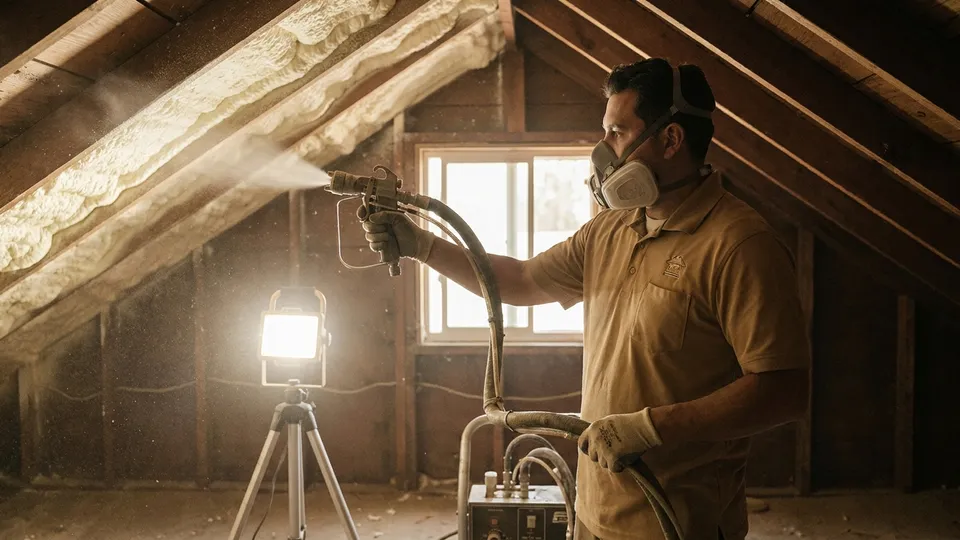
Spray foam insulation is worth it in San Diego for conditioned attics, cathedral ceilings, crawlspaces with moisture exposure, and any application where air sealing and insulation need to happen in a single pass. For a standard vented attic on a flat-ceiling home, blown-in cellulose or fiberglass will perform nearly as well for a fraction of the cost. The honest answer is: it depends on what your house actually needs, not what sounds most premium.
This post focuses on the decision itself. If you want line-item numbers for a spray foam job, check our spray foam insulation cost guide. If you’re weighing foam against cellulose specifically for an attic job, the spray foam vs cellulose post covers that comparison in depth. Here we’ll help you figure out whether your situation justifies the premium at all.
What spray foam actually costs vs what you get
Open-cell foam runs $1.50 to $3.50 per square foot installed. Closed-cell runs $3.00 to $5.00. Compare that to blown-in cellulose at roughly $0.90 to $1.50 per square foot, or fiberglass batts even cheaper. Spray foam costs two to four times more depending on the material and application.
What that money buys you is not just R-value. It’s air sealing built into the product. A well-installed blow-in job stops conductive heat transfer but doesn’t close every penetration, gap at the top plate, or joint around a recessed light. Foam expands into those gaps and seals them in the same pass. In a tight application like a rim joist or a crawlspace wall, that air seal is worth more than the R-value number suggests.
The question worth asking before any spray foam job: is my real problem missing R-value, or is it air leakage? In many San Diego homes, it’s both, and foam solves both. But if you already have decent insulation and the attic floor air-sealing was done right, adding spray foam on top doesn’t give you much for the money.
Where spray foam earns its premium in San Diego
Conditioned attics
A conditioned attic means you’re moving the thermal boundary from the attic floor up to the roof deck. HVAC equipment and ducts in the attic now live inside conditioned space, which matters because duct leakage into a 140°F attic is one of the biggest sources of cooling loss in an inland San Diego home.
Blown-in can’t do this job. It requires a horizontal surface to sit on. Spray foam applied to the underside of the roof deck, including the rafters, is the standard method for conditioning an attic. Open-cell foam at 5 to 7 inches on the deck is the common approach in coastal and inland valley zones. The investment is real, often $5,500 to $9,500 for a 1,500-square-foot attic, but so is the payoff if your HVAC is in the attic.
Cathedral ceilings
A cathedral ceiling has no attic above it. There’s a rafter bay, maybe 2x6 or 2x8 deep, and then roofing above that. You cannot fill that cavity with loose-fill. Batts alone leave gaps and don’t air-seal. Closed-cell spray foam is often the only practical way to hit your R-value target in a shallow rafter cavity while keeping an air barrier, especially in Title 24 climate zone 10 and zone 14 where R-38 is the target and you have maybe 7 inches to work with. Closed-cell at R-6.5 per inch can hit R-38 in about 6 inches.
Crawlspaces
San Diego’s coastal marine layer keeps ground moisture elevated, especially in neighborhoods close to the bay, lagoons, or low-lying areas. A crawlspace that isn’t properly sealed and insulated will pull humid air up through floor assemblies, causing musty odors, wood deterioration, and uncomfortable floors.
Closed-cell spray foam on crawlspace walls and the underside of the subfloor is the gold standard here because it adds a vapor barrier in the same pass. It’s not the only option, but it handles moisture and air sealing together in a tight space where installation access is miserable. Our crawlspace insulation guide covers when a combination of rigid foam and spray foam may make more sense.
Rim joists and band joists
These are the short vertical wood members at the perimeter of your floor framing, right above the foundation. They’re poorly insulated in most older San Diego homes and they’re significant air-leakage points because they’re surrounded by gaps. A small closed-cell spray foam job on the rim joists, typically $1,200 to $2,800, is one of the highest return-on-investment insulation upgrades in the county. It’s quick, relatively cheap, and targets a spot where every dollar of insulation actually reduces air exchange.
Tight, energy-focused new construction or major renovations
If you’re building new or doing a significant remodel and you want to meet aggressive energy performance targets, spray foam at the roof deck and rim joists combined with blown-in or batts in the walls gives you a high-performance building envelope without going all-foam everywhere. That layered approach usually performs better per dollar than specifying closed-cell throughout.
Where blown-in or batts are the smarter buy
A standard vented attic with an accessible, flat insulated floor is the clearest case for blown-in cellulose or fiberglass. The attic stays hot, but your living space is separated from it by a well-insulated ceiling. Blown-in cellulose at R-38 to R-49 with air-sealing done at the top plates beforehand will perform comparably to spray foam at a third of the cost. For this application, spray foam is generally not worth the premium.
Walls in a standard wood-framed retrofit are also usually better served by dense-pack cellulose blown in through small holes, or batts during an open-wall renovation, than by spray foam. Spray foam in walls can complicate future electrical and plumbing work because it bonds to the framing and is extremely difficult to remove cleanly.
The real downsides to know before you commit
Cost is the obvious one. Spray foam is significantly more expensive than every other insulation type. If you’re on a tight budget, getting the basics right with blown-in and dedicated air-sealing usually gives you better overall performance than spending the same money on spray foam in one area.
Tight homes need mechanical ventilation. When you condition an attic or significantly tighten a home with spray foam, you reduce natural air infiltration. That’s the goal, but it also means the home needs fresh air introduced deliberately. In most San Diego climates that means a basic energy recovery ventilator or at minimum controlled exhaust ventilation. This isn’t a dealbreaker, but it’s a real cost and a real conversation to have with your contractor before the work starts.
Removal is difficult. Spray foam bonds hard to wood, drywall, and concrete. If you ever need to remove it for a remodel, access a pipe, or replace damaged sheathing, you’re looking at a messy and expensive process. Blown-in just gets vacuumed out. Batts come out in minutes. Foam does not.
Open-cell foam is not a vapor barrier. In a coastal San Diego crawlspace or an application where you need moisture control, open-cell alone is not enough. Closed-cell is the right call for moisture-sensitive assemblies. Getting this wrong causes rot and mold, not energy savings.
Worth it / not worth it by scenario
| Scenario | Verdict | Reason |
|---|---|---|
| Conditioning an attic with HVAC equipment inside | Worth it | Only practical method; duct leakage savings are substantial |
| Cathedral ceiling with shallow rafter bays | Worth it | Only way to hit R-value in limited depth while air-sealing |
| Coastal crawlspace with moisture exposure | Worth it | Handles vapor control and insulation in one product |
| Rim joists and band joists | Worth it | High ROI, low total cost, targets a critical leak point |
| Standard vented attic, flat ceiling, no HVAC in attic | Not worth it | Blown-in at R-38/R-49 delivers comparable performance for far less |
| Interior stud-wall retrofit | Usually not worth it | Dense-pack cellulose is cheaper, equally effective, and reversible |
| Budget is limited, multiple upgrades needed | Not worth it | Air-sealing + blown-in delivers more improvement per dollar |
| New construction targeting high energy performance | Selective use | Worth it at roof deck and rim joists; blown-in elsewhere |
SDG&E rebates (and what happened to the federal credit)
SDG&E offers insulation rebates that apply to qualifying spray foam projects. The federal 25C tax credit expired for installs after December 31, 2025, so it’s off the table for new work. The remaining incentives don’t change the underlying cost-vs-benefit analysis by zone or application, but an active rebate can shift a borderline case toward “worth it.” Our SDG&E insulation rebates guide has current details.
What to do before calling anyone
Get an air leakage test or at least a basic energy audit before committing to spray foam. An energy auditor can tell you whether your home’s real problem is missing R-value or air infiltration, and which spots are contributing most. Spending $10,000 on roof-deck foam when your biggest issue was the attic hatch and three unsealed top plates is a common and expensive mistake. The air sealing guide explains why air sealing often delivers more than adding insulation on top of existing material.
If you’re trying to figure out whether spray foam makes sense for your specific home, we’re happy to look at it with you. Thermal Pro San Diego offers free assessments for San Diego County homeowners. You can schedule one at our contact page or call us at (858) 925-5546. We’ll tell you straight whether foam earns its cost in your situation or whether a different approach gets you further.