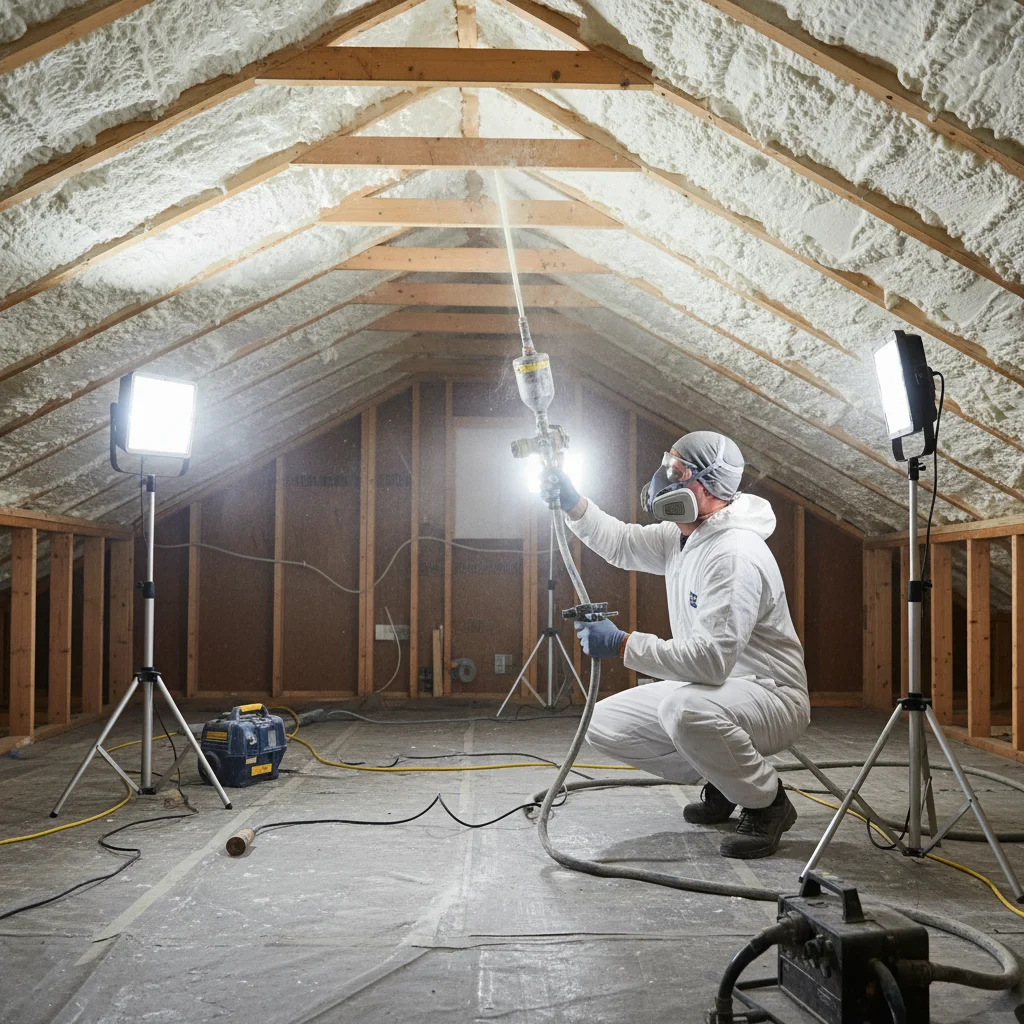
Spray foam insulation in San Diego County runs about $1.50 to $5.00 per square foot installed in 2026. Open-cell foam lands at $1.50 to $3.50, closed-cell at $3.00 to $5.00. A whole-attic roof-deck job on a typical 1,500 to 2,000 sq ft home usually falls between $5,500 and $13,000, depending on which foam you pick and how deep you go. That’s the short answer. The number that matters for your home depends on the area you’re insulating, your Title 24 climate zone, and whether you’re chasing cooling savings or full air-sealing.
Open-cell vs closed-cell: where the price split comes from
The two foams behave differently, and the cost gap is real.
Open-cell expands big, stays soft, and runs about R-3.7 per inch. It air-seals well and costs less, around $0.40 to $0.65 per board foot in material. It’s the right call for most San Diego attic roof decks and interior walls where you want air-sealing and sound control without paying for a vapor barrier you don’t need in a mild climate.
Closed-cell is dense, rigid, and runs R-6 to R-7 per inch. It doubles as a vapor barrier and adds structural stiffness, but material runs $1.00 to $1.50 per board foot. In San Diego, closed-cell earns its premium in crawlspaces, rim joists, and coastal homes where marine-layer moisture is a factor.
Here’s the practical read for our cooling-dominated county: San Diego doesn’t have brutal winters, so the vapor-barrier advantage of closed-cell matters less here than it would in a cold, humid state. For most attic and wall jobs, open-cell does the work for less.
Cost by application area
These are installed San Diego ranges for common spray foam jobs in 2026.
| Application | Foam type | Typical cost |
|---|---|---|
| Attic roof deck (1,500 sq ft) | Open-cell | $5,500-$9,500 |
| Attic roof deck (1,500 sq ft) | Closed-cell | $7,500-$13,000 |
| Wall cavities (retrofit, per 2x4 cavity sq ft) | Open-cell | $1.40-$2.30 |
| Wall cavities (retrofit, per 2x4 cavity sq ft) | Closed-cell | $3.50-$5.25 |
| Crawlspace (500-800 sq ft) | Closed-cell | $3,000-$6,500 |
| Rim joists / band joists | Closed-cell | $1,200-$2,800 |
| Garage ceiling or walls | Open-cell | $2,000-$4,500 |
National cost guides quote a $3,500 average and a range up to $30,000. Those numbers blend cold-climate net-zero builds with quick crawlspace jobs, so they’re close to useless for planning a San Diego project. The ranges above are scoped to how homes here actually get insulated.
Cost by climate zone (Title 24 changes the math)
San Diego County spans three Title 24 climate zones, and your zone sets the R-value code expects. That drives how deep the foam goes, which drives cost.
- Zone 7 (coastal: San Diego, Chula Vista, Coronado, Imperial Beach): Mildest zone. Attic targets around R-30 to R-38. Less depth, lower cost. Marine-layer moisture makes closed-cell worth a look in crawlspaces.
- Zone 10 (inland valleys: El Cajon, Santee, Escondido, San Marcos): Hotter summers, more cooling load. Attic targets R-38 and up. This is where roof-deck foam pays back fastest because attic temps hit 130 to 150°F by late spring.
- Zone 14 (desert edge / backcountry: parts of East County): Extreme heat. Higher R-values, plus travel time raises the floor on any quote.
If you’re in El Cajon or Santee and your upstairs bakes every afternoon, sealing the attic at the roof deck with foam is the upgrade that moves the needle. We cover how the code maps to depth in our Title 24 insulation requirements guide.
Why San Diego homes choose spray foam over blown-in
Most attics here get blown-in cellulose or fiberglass, and that’s the right, cheaper choice for a vented attic. Spray foam makes sense when you want something blown-in can’t do:
- Conditioning the attic. Foam at the roof deck brings the attic inside your cooling envelope, so ducts and equipment up there stop fighting 140°F air.
- Air-sealing in one step. Foam insulates and seals together. A leaky San Diego attic loses cooled air all afternoon, and foam stops it.
- Unvented or cathedral roofs. Low-pitch and cathedral assemblies are hard to insulate any other way.
If you’re weighing foam against loose-fill, our spray foam vs cellulose comparison breaks down where each one wins in our climate.
What drives your final number
Four things move a spray foam quote more than anything else:
- Square footage and depth. More area and more inches mean more material. Closed-cell at 6 inches runs $6 to $9 per sq ft in material alone.
- Access. A walkable attic with a centered hatch is straightforward. Low clearance, tight crawlspaces, and split attics add labor.
- Old insulation removal. Fouled or water-damaged material has to come out first, usually $1.50 to $3 per sq ft before any foam goes in.
- Foam choice. Open-cell vs closed-cell is the single biggest lever, often a 40 to 60 percent swing.
Rebates and credits that lower the cost
Spray foam qualifies for the same programs as other insulation upgrades, and we document the work so your paperwork is clean.
- Federal 25C tax credit: expired for installs after December 31, 2025, so 2026 spray foam jobs don’t qualify. Jobs completed in 2025 can still be claimed on your 2025 return.
- SDG&E programs: SDG&E periodically offers insulation rebates tied to whole-home energy efficiency programs. We help you check current eligibility before the job.
- PACE / HERO financing: for qualifying homes, finance the upgrade through your property tax bill.
Full breakdown of what’s available this year is in our SDG&E insulation rebates guide.
Frequently asked questions
Is spray foam worth it in San Diego’s mild climate? For a vented attic, blown-in is usually the smarter spend. Foam is worth it when you want to condition the attic, seal a leaky envelope, or insulate a cathedral or unvented roof. In hot inland zones like El Cajon and Santee, roof-deck foam pays back faster on cooling bills.
Open-cell or closed-cell for a San Diego attic? Open-cell, in most cases. It air-seals well, costs less, and our cooling-dominated climate doesn’t need the vapor barrier closed-cell provides. Closed-cell makes more sense in coastal crawlspaces where marine-layer moisture is a factor.
How much does spray foam cost per square foot here? Open-cell runs $1.50 to $3.50 installed, closed-cell $3.00 to $5.00. Total attic jobs typically land between $5,500 and $13,000.
Does spray foam meet Title 24? Yes, when installed to the right depth for your climate zone. Zone 7 coastal homes need less depth than Zone 10 inland or Zone 14 desert-edge homes. We size the job to code and document the R-value.
Can you spray foam over existing insulation? At the roof deck, we usually remove old attic-floor insulation first so the attic becomes a sealed, conditioned space. In walls and crawlspaces it depends on the condition of what’s already there. We tell you straight after the inspection.
How long does a spray foam job take? Most attic and crawlspace jobs finish in one to two days, including cure time before reoccupancy. Larger or multi-area projects run longer.
Get a real number for your home
Every quote here is upfront and flat-rate, no surprises after we start. We cover all of San Diego County, size the foam to your Title 24 zone, and help you check current SDG&E rebate eligibility before any work begins. See our spray foam insulation service for scope details.
If your upstairs runs hot every afternoon or you’re tired of cooling air that leaks straight out the attic, we’ll give you honest numbers for your specific home. Call (858) 925-5546 for a free in-home estimate.