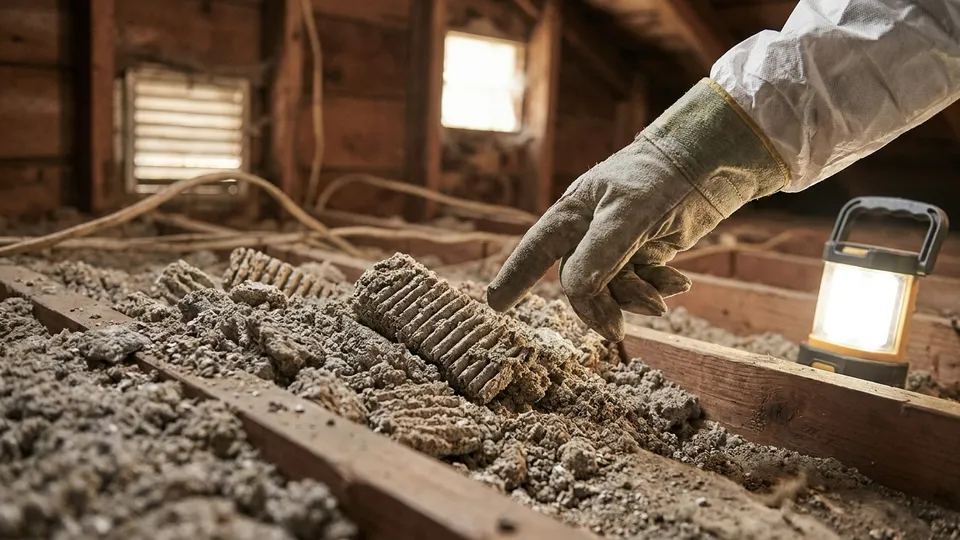
If your San Diego home was built before 1990 and has a layer of gray-brown, pebble-like loose-fill in the attic, there’s a real chance it’s vermiculite. Not all vermiculite contains asbestos, but the majority of what was sold in the U.S. before 1990 came from a single mine in Libby, Montana that was heavily contaminated with asbestiform tremolite. Until tested by a certified lab, treat it as suspect. Do not disturb it, bag samples yourself, or blow additional insulation on top of it.
What vermiculite looks like
Vermiculite is a naturally occurring mineral that expands when heated, producing a lightweight, porous pellet. In attics, it looks like a layer of small, irregular pebbles, usually gray-brown or silver-gray in color. It’s typically installed as loose-fill, either blown or poured between joists. Depth varies from 2 inches to 6 inches.
The most common brand was Zonolite, sold widely. If you find old bags or cans in the attic or garage labeled Zonolite, that’s a strong indicator of what’s up there.
Vermiculite is visually distinct from other attic insulation types:
| Insulation type | Appearance | Texture | Typical color |
|---|---|---|---|
| Vermiculite | Small pellets, irregular | Gritty, pebble-like | Gray-brown or silver |
| Blown-in cellulose | Fluffy, dusty | Soft, fibrous | Gray or light gray |
| Blown-in fiberglass | Fine, wispy | Light and cottony | White or yellow-white |
| Fiberglass batts | Flat blankets | Soft, fuzzy | Pink, yellow, or white |
| Rock wool (older) | Dense loose-fill | Coarser fibers | Gray or dark brown |
If you’re unsure what you’re looking at, a photo from the attic access hatch is usually enough for a contractor to make a preliminary ID without disturbing anything.
The asbestos connection
The Libby, Montana mine (operated by W.R. Grace and Company) supplied the vast majority of vermiculite to the U.S. market for decades. The ore body at that mine contained naturally occurring asbestos. When vermiculite was processed and shipped, asbestos fibers came with it.
The EPA estimates that the majority of vermiculite attic insulation installed in the U.S. before 1990 came from Libby. That’s not a guarantee that your specific attic is contaminated, but the base rate is high enough that the EPA’s current guidance is to treat all pre-1990 vermiculite as if it contains asbestos until certified testing proves otherwise.
Asbestos is hazardous when fibers become airborne and are inhaled. Vermiculite that is sitting undisturbed under several inches of settled material poses a lower risk than material that has been recently disturbed, crushed, or is in a high-traffic area. But any disturbance can release fibers, so the answer is always: don’t touch it until you know what you’re dealing with.
What not to do
A few common mistakes homeowners make, usually before they realize what they have:
Don’t disturb the material. Walking across it, digging through it, or vacuuming it with a household vacuum will push fibers into the air and potentially into the living space below.
Don’t collect your own samples. Scraping material into a zip-lock bag is a disturbance event. If the material is asbestos-positive, you’ve just aerosolized fibers without any respiratory protection.
Don’t blow new insulation on top. Adding blown-in cellulose or fiberglass over untested vermiculite doesn’t seal it in safely. Any future attic work will disturb both layers.
Don’t call a general insulation contractor. Asbestos-containing material removal is a regulated scope in California, requiring a state-licensed asbestos abatement contractor. A standard insulation crew cannot legally handle it, and a reputable one won’t try. See our notes on insulation removal for how we separate those scopes.
How testing works
Testing requires a certified industrial hygienist or asbestos inspector to collect samples under controlled conditions using proper PPE and protocols. They take a small amount of material from multiple locations in the attic, package it correctly, and send it to an accredited lab. Lab results come back in two to five business days for standard turnaround, faster for rush.
The lab report will show whether asbestos fibers are present and, if so, what type and at what percentage. California considers material with 0.1% or more asbestos by weight to be asbestos-containing material (ACM), which triggers the licensed abatement requirement.
If the test comes back negative, you have options: you can leave it in place if it’s in good condition and your R-value needs are being met, or you can have a standard insulation contractor remove and replace it. If it tests positive, you need a licensed abatement contractor before any other work can happen.
Thermal Pro coordinates the testing process. We bring in a certified inspector, stand back while they collect samples, and then walk you through the results. We don’t take shortcuts on this step.
What licensed abatement looks like
When vermiculite tests positive for asbestos, removal is a defined process under California regulations and OSHA standards. Here’s what a licensed abatement typically includes:
Containment. The attic access is sealed. Negative air pressure is created in the work area using HEPA-filtered exhaust units. This keeps fibers from migrating into the living space below.
PPE. Workers use full Tyvek suits, gloves, and half-face or full-face respirators with P100 HEPA filters. This is not optional, it’s required by law.
Wet removal. The material is dampened before removal to suppress fiber release, then carefully scooped and bagged into heavy-duty poly bags that meet EPA disposal requirements.
Air monitoring. During and after removal, air samples are collected to confirm fiber levels in the work area meet clearance standards before the containment is dismantled.
Disposal. Asbestos-containing material is classified as a hazardous waste in California. It goes to a licensed Class II hazardous waste landfill, not a standard construction debris bin.
Clearance inspection. A final visual inspection and air sample confirm the area is clear before the containment comes down.
Abatement cost varies by attic size and depth of material. As a general range, asbestos removal from a residential attic in San Diego County runs between $2,500 and $8,000, depending on square footage, depth, and access conditions. Get that number from your abatement contractor; we won’t quote what isn’t ours to do.
What happens after abatement
Once the licensed abatement contractor signs off on clearance, the attic is an empty, clean surface ready for new insulation. This is where Thermal Pro comes back in.
Most homes that had vermiculite were built before modern energy codes, which means the attic floor is severely under-insulated by current standards. After abatement, the crews we send install fresh attic insulation to bring the assembly up to the R-38 to R-49 range that Title 24 targets for most of San Diego County.
Depending on the attic and what we find once it’s clear, we typically recommend blown-in fiberglass or cellulose for re-insulation. Both are inert, non-toxic, and appropriate for finished and unfinished attic assemblies. We also do a pass of air sealing at the attic floor before the new insulation goes down, which is the single highest-impact energy efficiency step in most older homes.
If you have questions about what material type makes sense for your attic, our insulation removal page covers the full scope of what we do before and after the abatement step.
What to do if you find vermiculite
Here’s a plain summary of the steps:
| Step | Who does it | What it involves |
|---|---|---|
| Identify | You or a contractor | Visual ID from attic access, no disturbance |
| Test | Certified asbestos inspector | Sample collection and certified lab analysis |
| Abate (if positive) | Licensed abatement contractor | Containment, wet removal, hazardous disposal, clearance |
| Re-insulate | Insulation contractor | Blown-in or batt installation, air sealing |
Don’t skip steps or combine them. Each one requires a different license and a different set of protocols.
If you’ve found what looks like vermiculite in your attic, or if you’re not sure what you have, we’ll come out and take a look. We won’t charge you for an initial assessment. From there, we’ll coordinate the inspector and the abatement contractor if needed, and then handle the re-insulation ourselves.
Call us at (858) 925-5546 or contact us here to schedule a no-pressure visit. We work with pre-1990 homes across San Diego County regularly, and we know how to move through this process without turning it into a bigger project than it needs to be.