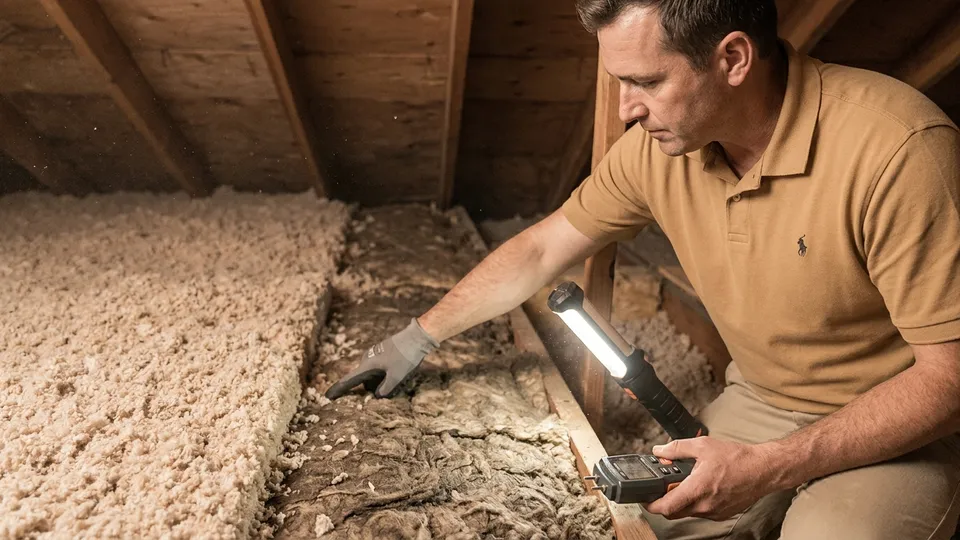
If your attic insulation is more than 15-20 years old, has water stains, smells musty, or shows signs of rodent activity, it needs to be replaced, not topped up. In most San Diego homes, full removal and reinstallation is the right call when any of the seven signs below are present. A straight top-up works only when the existing material is clean, dry, uncompressed, and undamaged.
Here’s how to tell the difference.
7 signs your attic insulation needs to go
1. Your energy bills keep climbing
SDG&E bills that jump year over year, especially in summer when air conditioning runs hard, often point to a failing thermal envelope. Insulation doesn’t age evenly. Blown-in cellulose and fiberglass both settle over time, and settlement cuts effective R-value even when the depth looks adequate from below.
If your bills have risen 15-25% without a rate increase to explain it, have someone measure actual depth across the attic floor. Most San Diego homes in Title 24 climate zones 7 and 10 need R-38 to R-49. If measured depth is significantly below that, the math on replacement usually pencils out within three to five years through energy savings alone.
2. Uneven temperatures room to room
Rooms above the attic should feel roughly the same as the rest of the house. When you notice one bedroom running noticeably hotter in summer or colder in winter than the adjacent room, the insulation directly above it is likely thin, compressed, or missing entirely.
This happens most often near attic hatches, above recessed lights that have been blown out over the years, and along eave edges where installation was shallow from the start. Spot failures like these are worth addressing, but if the pattern is widespread, partial repair is usually a losing approach.
3. Water stains, discoloration, or wet spots
Water is the fastest way to destroy insulation. Fiberglass batts mat flat when wet and don’t recover their loft. Cellulose clumps and can harbor mold spores even after it dries. Spray foam is the exception, but it’s rarely installed in older San Diego attics.
Any visible brown streaking, dark patches, or areas where insulation looks sunken and compacted deserve investigation. Find the moisture source first (roof leak, AC condensate line, bathroom exhaust duct that terminates in the attic instead of outside). Once the source is fixed, the damaged material comes out entirely. You can’t salvage it with drying.
4. Evidence of pest or rodent activity
Rats and mice are a real problem in many San Diego neighborhoods, particularly in older homes near canyons or open space. Rodents shred blown-in insulation for nesting material, tunnel through batts, and contaminate everything they touch with urine and feces.
Contaminated insulation is a health hazard. It can’t be cleaned. Full removal, sanitizing the attic decking, and reinstallation with a new product is the only appropriate response. Our insulation removal service covers the full process, including debris containment and haul-out.
5. Settled or compressed fill
Blown-in insulation compresses gradually under its own weight. Fiberglass batt insulation can also sag between joists or get compressed by HVAC equipment, stored boxes, or foot traffic from HVAC technicians over the years.
An inch of settled cellulose at R-3.7 per inch loses meaningful performance compared to freshly installed product at R-3.5-4.0 per inch, but the bigger issue is when significant settlement has occurred across the whole attic floor. If you’re looking at 4-5 inches of product that should be 10-12 inches, you’ve lost a third to half your R-value. That’s not a top-up situation. The compressed material should come out so the new product goes in at the right depth.
6. Mold smell or visible mold
A persistent musty or earthy smell in rooms directly below the attic, especially after rain, is a warning. Visible mold on insulation, wood sheathing, or rafters means moisture has been sitting long enough to grow biology.
Mold in insulation is not a surface problem you can spray and seal. The affected material needs to come out, the substrate needs to be treated, and the moisture pathway needs to be closed before new insulation goes in. California contractors are required to follow specific remediation protocols for mold-containing work. Skipping that step means the mold comes back under the new insulation within a season.
7. Insulation that’s 15-20 years old or more
Age alone isn’t a reason to replace insulation if everything else checks out. But it’s a reliable trigger to get an eyes-on assessment. Homes built decades ago in San Diego typically have R-19 or less in the attic, well below current Title 24 targets of R-38 to R-49 depending on climate zone.
Older insulation also predates modern air-sealing practices. The two work together. Insulation slows conductive heat transfer; air sealing stops convective losses through gaps, penetrations, and the attic hatch. If you’re replacing 20-year-old insulation, it’s worth doing air sealing at the same time rather than adding that cost as a separate project later. Read more about why sequencing matters in our post on air sealing before insulation.
Top-up vs. full removal: how to decide
Not every situation requires full removal. Here’s a practical breakdown:
| Condition | Top-up | Full removal + replace |
|---|---|---|
| Clean, dry, uncompressed existing material | Yes | No |
| Depth below target R-value but otherwise sound | Yes | No |
| Water damage or wet spots | No | Yes |
| Rodent contamination | No | Yes |
| Mold present | No | Yes |
| Odor from biological sources | No | Yes |
| Heavily compressed across most of attic | No | Yes |
| Material is pre-2000, unknown condition | Inspect first | Often yes |
| Fire damage or smoke exposure | No | Yes |
The honest answer is that top-up is the right call less often than homeowners hope. If the existing material has any of the contamination or damage issues above, adding new product on top traps the problem and doesn’t solve it. It also makes future access for repairs and HVAC work harder.
For situations where the existing insulation is genuinely clean and only thin, adding blown-in on top of existing batts or fill is straightforward and cost-effective. Our post on what insulation removal actually costs breaks down when the investment makes sense financially.
What the replacement process looks like
Full attic insulation replacement runs in a predictable sequence:
Step one is removal. All existing material is vacuumed out using commercial insulation vacuums, bagged, and hauled off the property. The attic decking is inspected for moisture damage, mold, pest entry points, and structural issues.
Step two is air sealing. Every penetration, gap around top plates, recessed light housing, and attic hatch gets sealed before new insulation goes in. This step is often skipped by contractors who want to move faster. It shouldn’t be.
Step three is installation. New material goes in to the depth required for your climate zone. In Zone 7 (coastal San Diego), that’s typically R-38 minimum. Inland Valley (Zone 10) and East County locations often warrant R-49.
Step four is documentation. A completed job should include photos of final depth measurements at multiple points, the product specifications, and the contractor’s credentials. Thermal Pro provides all of this on every job.
Financial side: rebates and tax credits
The federal 25C tax credit expired for installs after December 31, 2025, so replacement jobs done in 2026 don’t earn a federal credit. If your work was completed in 2025, you can still claim it on your 2025 return.
SDG&E offers insulation rebates that vary by product type and R-value added, and rebate levels change with funding cycles. Our post on SDG&E insulation rebates for 2026 has current figures. On a job that typically runs $1,500-$4,500 for a San Diego home, an active utility rebate is a modest but real offset; confirm what applies at quote time.
How we can help
If you’re unsure whether your attic insulation needs replacement or just supplementing, a free on-site assessment gives you a clear answer. We’ll measure what’s there, check for damage, and tell you honestly what the situation calls for. No pressure, no upsell if a top-up is all you need.
Reach out via our contact page or call us directly at (858) 925-5546.